Nam June Paik, a transnational artist from South Korea

Artists of color have their special meanings for mediating the transnational subjective and connecting the separated dots of identities throughout the continents. Nam June Paik, who is well known as a media artist, was born in Seoul, South Korea during the Japanese colonial period. At the time, there were many diasporas moving to other countries like China and Japan to escape from the political chaos. Paik’s family has also moved to Japan before the Korean War was started. He studied Aesthetics and Composition in Tokyo University and moved to Germany after his graduation to continue his study for Philosophy and Musical History. In Germany, he met John Cage, an American composer who once participated in the Fluxus Movement, and got inspired by his liberal spirit and his unique destructive approach toward the music and sound. Paik then does his active work as an outstanding performing artist. 

Paik’s famous works include: <존 케이지에게 보내는 경의: A respect sending to John Cage>, which he performs to smash a piano with an ax, and <피아노 포르테를 위한 연습곡: An etude for piano forte>, which he cuts the necktie that John Cage was wearing. Paik himself says he has expressed the clusters of the ideas about an impact, a climax, and an astonishment, calling his whole performance works are created under the expressionism and the romanticism. He continuously shows an iconoclastic installation works to show the avant-garde characteristics of his own, and in the 1960s, Paik does a work named “Opera Sextronic,” where he tries to put sexual connotations into the musical performance. 

During this work, a cellist Charlotte Moorman tries playing her cello with her naked body. She actually gets caught by the New York State officer for the misdemeanor charge, but this incident then triggers to amend the New York State federal law that the state cannot punish the nudity in the artistic scene. Allan Kaprow, a famous American performance artist, called Paik as a “cultural terrorist” came from Asia since Paik has broken all the cultural border lines in the field of art by representing his unique Korean diaspora identity to the foreigners and addressing the ontological problems as an artist of color. 

I see artists who work transnationally as global-nomads, who pursue purposeless freedom and do their best to show their complex identities. We should feel thankful to their hard work as opening up the new opportunities for the others to set their foot into the multicultural society and reconstruct their misinterpreted identities as colored people. When Paik says, “Art is not the Olympic, and the cultural patriotism wins the political patriotism,” he should have meant that people from various cultures should step up to show their diverse identities in a more aggressive way since there are no such things as dominant ideologies of nation, race, gender, or anything people categorize the others into. 

Just like an emergence of the term “Global Contemporary,” created after Kate-hers RHEE’s art exhibition in Germany, artists from transcultural backgrounds should never succumb to the dominant cultures, but try to narrate incessantly their unique identities to strike the preexisting cultural norms and stereotypes that have been put upon the faces of artists of color .
Transnational Communities

Kim, in Producing Missing Persons, talks about how art produced by Korean adoptees help in “understanding the role of art in mediating transnational subjectivities and construction new transnational social imaginaries…” Of particular interest to me are the ways in which diasporic communities are able to imagine social relations that extend across borders. An example of these relations appear in RHEE’s Schicke Möpse video, where the parody of breast surgery testimonials rely on the translation of German to produce a punchline. RHEE’s video extends the idea of Korean diaspora and conversations about Korean bodies and beauty from beyond the confines of Korea’s geographical borders. Thus, the influences of Western beauty standards, as they relate to breasts, are relevant to not just Asian bodies, but also specific to the national identities that these bodies identify with. Additionally, Schicke Möpse is an example of how adoption and diaspora can be backdrops for artistic creation, but are not “assumed to be organized around a search for wholeness,” that adoptee art often becomes pigeonholed as (Kim 84). However, while RHEE’s status as an adoptee informs my interpretation of her art, I am wary of categorizing her work as having adoption as its sole focus. Rather, the contrary is true where adoption informs the art but is not central nor crucial to the main message of the video.

The creation of transnational imaginaries occurs primarily through artistic mediums. This Vice video series, “The Rise of Trap in Southwest Asia,” looks at some of the record labels, rappers, and consumers of rap music in Chengdu, China. The video outlines the existence of a new transnational imaginary, one that connects American rappers likes Jay-Z and Eminem to transnational ones like Shady and Higher Brothers through their art. One rapper, TY, talks about how being a rapper is equivalent to being a ‘boss.’ I believe that being a ‘boss,’ refers to the economic and creative freedom that comes with marketing his creative brand as a product. To be a boss, you “make yourself into a business, a product.” Through his art, TY is able to draw upon black aesthetics to connect to a community of consumers within China. To an outsider, I think of these rappers as being “Chinese rappers,” a delineation based on their nationality. However, TY’s rhetoric suggests an individualistic bent to his art, one that doesn’t place as much emphasis on national identity or transnational community. Just as how RHEE’s work is informed by her status as a transnational adoptee, it seems appropriate to say that TY’s work is only informed by his identity as Chinese. Thus, the Vice documentary exposes how like RHEE’s work, art creates imagined communities, ones that are complicated by national identities. It seems that from a Western view, there is an omnipresent urge to locate art within a nationalistic context, even when those national identities detract from the messaging of the work.


Adoptee Subcultures Participating in Art Activism

 Military involvement had been a common cause of many issues in Korea such as prostitution and children in the streets of Korea during the 1950’s. The stigmas in Korea against mixed-race Korean kids was the main reason the children were sent away to be adopted or live in foster care in the West. Men were prioritized in sustaining from adoption throughout this process in the early 1950’s . In Eleana J. Kim’s article “Producing Missing Persons: Korean Adoptee Artists Imagining,” Kim mentions the Korean boys adopted into Western families joining communities to find identification which shows the importance of the internet and how the media can help find individualism and identification with their lost community. 

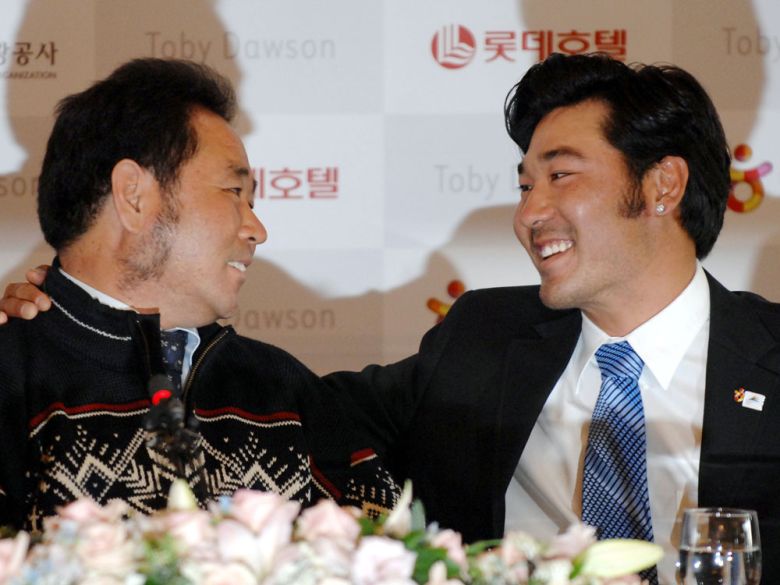
An example of the struggle of self identification would be the successful Olympic skier, Toby Dawson. In class we watched a news story about his trip back to his home country after having a victory at the Olympics in 2006. When South Korea heard of his success and that he identified as Korean-American, they took initiative to find his birth parents in Korea and invite him to their country. He was relieved and emotional to finally be able to return to “home” and be accepted. He talked about how his mother was possibly treated and how he was treated for not being a pure race Korean. 

Toby Dawson and his biological father in Seoul on Feb. 28, 2007GETTY IMAGES

Social belonging is a huge issue among mixed race children. For example you hear of mixed black children being too “white” for their black peers, and too “Black” for their white peers causing a dissociated interaction throughout their growing and educational years. Same can be said for Korean mixed-Race children and feeling a sense of not belonging.

The “emergence of the adult adoptee subculture” became a product of the social isolation of these adopted mixed-raced Korean’s which turned into a great community for other adults trying to find themselves among their culture. From these adoptee subcultures they started participating in “community and the global art world” (KIM 77). This formed a community trying to help with the cultural displacement of the adult adoptees. Mostly photography and movies are made to give a valid and surreal representation of the life of an adopted child growing up in the West which gives them “greater self understanding” (Kim 78). KIM also mentions in her article that the adoptee artwork is a form of activism and brings cultural awareness to surrounding peers in their communities or outside of their communities. It could be analyzed and claimed that Toby Dawsons art contribution to this community would be his career in skiing and his interaction with his family that came from his growing fame as an athlete. 

The Art of Being Uncomfortable

Nobody likes being uncomfortable. It is one of our basic instincts as humans to avoid being uncomfortable at all costs. Because of this, many artists are using that discomfort to get across their message by making us face what exactly it is that makes us uncomfortable. One artist who utilizes this beautifully is kate-hers RHEE. RHEE’s pieces force the viewer to witness the reality of many things that we find more comfortable to ignore.

Much of RHEE’s work involves audience participation, something that makes most people’s skin crawl. For many people, they attend an art show with a sort of voyeuristic intent. They are there to observe, but not contribute. An audience that functions in this way would not be truly anything from RHEE’s work. Much of her work is asking the audience to confront their own feelings and beliefs. Being simple observers does not allow for this. By making the audience participate in these acts, RHEE forces them to confront their own racism, such as in N-Kissing Booth. That usually makes people pretty uncomfortable. Even the most “woke” person attending an experimental performance art piece is not immune from the subtle ways racism and sexism can seep into oneself.

By making people uncomfortable, RHEE gives her audience no other option but to examine those feelings. One has to ask themselves, why exactly am I uncomfortable? Why does this bother me? Is it because this is something that I have been contributing to my whole life? Or perhaps its because this is something that I was completely unaware of prior to watching this woman be force-fed saltines? Discomfort forces people to examine their privilege, their actions, their psyches, etc. -things that are most comfortable to ignore. In this discomfort, people can find unity. People feel uncomfortable, and automatically think “we have to do something about this”, so they can stop feeling uncomfortable. This serves as a call to action. Whether it be about food culture, or the shady morality of Korean adoption, the discomfort RHEE makes them feel about the subject makes them want to do something – anything – to stop feeling this discomfort. That is how change can actually happen, and why discomfort is truly powerful.

Non/Korean Contemporary Artists

Hein Kuhn-Oh is a Korean, born-and-raised contemporary artist. After high school, he moved to the United States and studied art and photography in California and Ohio. Although he is not an adoptee artist like those mentioned in Kim’s “Producing Missing Persons,” there are enough similarities in his artistic interests to those described in Kim’s article to make a comparison.

Kim explains that due to the “lack of collective cultural forms, symbols, or images,” the subculture of adoptee artists have found a common interest in photography, abstraction of cultural Korean images, as well as concepts of performance rather than autobiographical finding, in their works. Maya Weimar’s “Seven Families” project includes photographs of the artist posing with tourists and attaching false narratives about her adopted family. Here, photographs which are often deemed as documentary and factual, disrupt the common stereotypes and narratives attached to Korean adoptees and their families. Similarly, Hein Kuhn-Oh is drawn to photography for its documentary, or rather posed documentary possibilities. In an artist profile, he calls photography a document, rather than a documentary form. His most famous works are various portraiture series such as ‘Ajumma’ (1999) and ‘Cosmetic Girls’ (2009) in which he photographs personalities and stereotypes for their external appearances to highlight prejudices in Korean society. Neither Maya Weimar nor Hein Kuhn-Oh are interested in truly identifying the person who is subject to their work, but rather highlighting meaning and reactions to personhood. Both artists have photographed Asian and Caucasian bodies, and both artists travel internationally for work and exhibitions, yet their motivations are inherently different. In “Missing Persons,” Kim explains that adoptee artists will always have a strong sense of activism, in ways that non-adoptee artists won’t, but kate hers is against the notion that adoptee art can only ever be adoptee art. So how do we consider adoptee artists in comparison to Korean born-and-raised artists like Hein Kuhn-Oh? No matter how similar the work, the history of diaspora attached to adoptee artists will continually be attached to the art they produce. No matter how abstract or conceptual, will adoptee artists only ever be exhibited in adoptee artist exhibitions? What if Maya Weimar and kate hers create works not related to dislocation or their adoptee identity, will their work still be conceived as adoptee art? As I mentioned before, based on their success and careers, artists like Hein Kuhn-Oh and Maya Weimar get to travel and exhibit internationally, they studied art in the United States, they photograph the same bodies, and question collective personhood and responses to physical appearances in their work- so where or what is the line that separates them?

http://www.heinkuhnoh.com/index.html?d1=01&d2=04&d3=&lang=eng

Importance of Interactive and Educational Performances

I love how Kate-hers RHEE transforms the art of activism and protests by turning them into a performance art with an underlying message with audience interaction. Of course walking protests, journal articles, and even social media posts can make a difference in starting change, but I think what RHEE has discovered in activism for Cultural Resistance is truly phenomenal. 

In Brett M. Van Hoesen’s article he mentions RHEE’s demonstrations of performances that are groundbreaking to “make visible to the majority what is experienced by the minority.” By actively demonstrating what is experienced by the minority such as effects of white privilege or racist micro-aggressions, this forcibly makes the audiences unable to not participate or see the effects of these racist issues. They also make audiences mentally understand the importance of understanding stereotypes and racist etymology represented in performances such as the N-kissing Booth and the food art intervention Minimally Korean which touched on “White Privilege.” Before reading this piece, I had never thought of the West’s attitudes of owning other cultural foods and acting of ownership until reading this article and thinking about asian food markets or streets stands that we find in the United States or outside of it.  

I think what is most brilliant about RHEE”S implements of the reward system is how it recruits participants in her performance, but it is also achieving making viewers understand the message she is trying to get across in having the audience’s personal confrontation of their own involvement in racism. I think this is important to have more interactive plays or performances with underlying messages. I think performances like the ones mentioned should be more advertised or instilled upon the performance culture. It is a lot better than simply writing or tweeting about an issue such as race, privilege, or entitlement. 

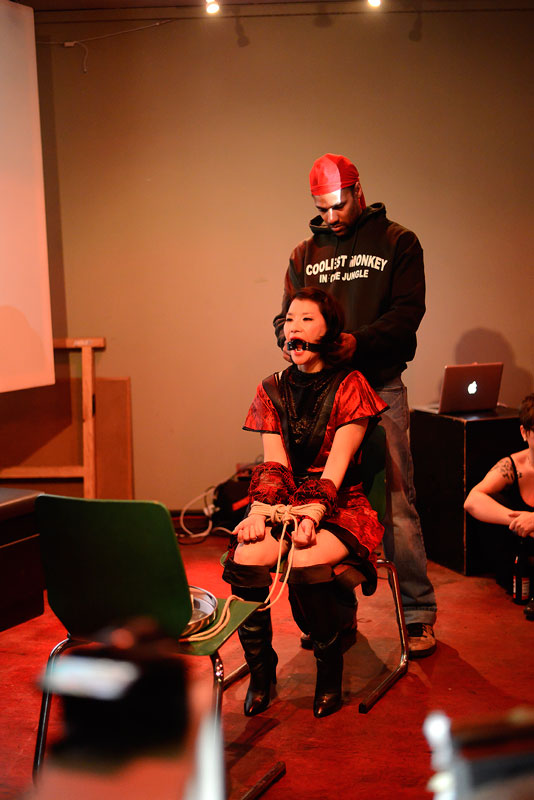
photo credit: Schirin Moaiyeri 2018

놓침 (missing)

In Kate-Hers Rhee’s 2006 video 놓침 (missing), she opens the video with an extended clip of her sitting on a chair in a field excessively shoving Nabisco Premium saltines (read: crackers, aka a popular term often used to describe whiteness and white people) down her throat, causing crumbs to spill all over her lap. She then conceals her eyes with a black bar, further taking away her individual identity. Such is a not so subtle, symbolic visual Rhee employs to describe the experience of being a Korean-American adoptee, specifically one that was a part of the adoption process motivated by Christian American ideals.

놓침 (missing), HD, single channel video, 2006 from 이미래 on Vimeo.

In the same 8 minute video, Rhee goes on Korean national television, speaking in Korean in an effort to search for her birth parents. She is standing next to an ironic “missing persons” poster of herself, pointing to her missing Korean identity and yet employing it at the same time through the Korean language. 놓침 (missing) was deliberately the last work Rhee created about her adoption.

On her website, Rhee writes: “Despite being in solidarity with the many adoption rights movements and activists worldwide, she does not identify with the word, Adoptee, and rather recognizes her abandonment and subsequent adoption as a past act that was done to her, but ceases to define her. In addition, parents who choose to adopt have identities outside of this act and are not usually called Adopters; albeit this term is sometimes used (pejoratively) within adoption circles of those who were adopted.”

Eleana Kim includes Rhee in her essay “Producing Missing Persons: Korean Adoptee Artists Imagining (Im)Possible Lives,” chronicling the Korean adoptee diaspora and their subsequent artistic community (aided by the advent of the internet in the 1990’s and increased number of adoptees seeking art educations). Kim writes that these “adult adoptees” have created “vibrant networks of collaboration and exhibition, making their work more visible and accessible to the broader adult adopted Korean community and the global art world” (Kim, 77).

Kim calls the works produced by this artistic collective as “experimental” and “conceptual,” and as “as representing and/or performing “missing persons” rather than depicting the autobiographical lost-and-found or search-and-reunion narrative organized around a quest for the ultimate truth of adoption or one’s ‘real’ identity. The missing persons in this work are, not long-lost natal kin or the already forfeited authentic self, but, rather, products of the radical contingency effectuated by adoption as a form of displacement and exile” (Kim, 78).

This description Kim provides is evident in Rhee’s explanation of her own work, the “Missing Persons Project.” Rhee calls adoption “forced emigration,” citing the fact that Korea “exports” 3-4 babies a day (statistic pulled from 2008, which makes me question if these numbers have changed in the last 11 years). Rhee does as Kim writes, actively questioning this cultural product, further calling out the facts that Korean families illegally abandon their children, Korean hospitals and adoption agencies coerce parents into giving up their children (mothers often unaware of the relinquishment of their child), and that the Korean “state then fabricates the child’s status as “orphan” in order to lawfully expedite the export to the Western receiving countries.” Ultimately, Rhee’s work not only explores her identity, but also questions the legality and morality of the modern adoption process in Korea.

Rhee’s work and Kim’s essay reminded me of an incredible SCA Senior Honors Thesis that I had the privilege to hear about this past Friday at the SCA Honors Conference. Senior Margaret Angela Ying Yannopoulos’ thesis (she is a Korean adoptee herself, I believe, who presented right after me that day!), titled “In The Face of Society’s Insistence on Race-Based Identifications, Asian Adoptees Construct Ontological Adoptee Kinships,” unpacks exactly what we’re discussing this week.

From the “Other” to “Authentic”

In Eleana J.Kim’s reading Producing Missing Persons: Korean Adoptee Artist Imagining (Im)Possible Lives, she lists several different artists that delved into the notion of the cultural identity crisis for Korean oversea adoptions. I was especially interested and drawn to Kate-hers Rhee’s artworks and performance arts as it implicitly lead the audiences in thinking about their own identity but also creates a queer link between pop culture and the media to adoption and cultural identities.

In Kate-hers Rhee’s artwork Missing Persons Project, she performed an act of sticking missing persons posters of herself around the hospital at which she was born in. Of course, she was not missing but it ironically shows her struggle of being a forced immigrant as she finds herself lost in her triple identity as she was an oversea adoptee herself as wanders around her Korean, American and German identity.

While raising awareness of the danger and risk of oversea adoption, she also focuses on how media and pop culture have potentially helped many families to reunite. As technology and pop culture emerges and works together, media platforms become the dominating space for an adoptee to connect and possibly reunion with their birth parents. This in a way also ironically reflects the despair within the Missing Persons Project. In a way, Rhee is aware that no one will be able to identity or actually “find” the girl (herself) printed on the paper. Not only because it was herself, it also shows how dependent we are on alternative methods of reunion through the failure. The project can also be viewed in a rather cyclical way as it shows how much the society is being commercialized where even the finding of people becomes a story to be made exciting for the audience.

Not only does Rhee raise the awareness of Korean oversea adoptees and how it interconnects with the media, she also takes a step further in challenging her korean identity. In another interactive performance piece Transkoreaning, Rhee presented a transformation process of herself from a rather western thinking (as she have stayed in Germany for over 10 years) to being embedded with South Korean culture through the use of social media. Through the employment of the internet and social media in particular (such as vlogging and blogging), she had made the audiences rethink how to approach the notions of cultural identity and “modern South Korean identity cliches and stereotypes” as it have been “further perpetuated by the popularity and dissemination of Hallyu”. Narrating in her non-native level of Korean, over the three months, she have not only transformed her communication ability in becoming an “authentic Korean” but have also showed the progress of how she changed her ethnicity and image of being an Korean woman through the influence of cultural presentations on the internet and from her surroundings. What makes this performance appealing and exciting is because it not only engages with herself as an individual but also deals with herself as the “other” by explicitly showing the struggle of embodying a transnational cultural identity.

What Art Can Do: visual art and the re-imagination of adoptee identity

Eleana J. Kim’s Producing Missing Persons: Korean Adoptee Artists Imagining (Im)Possible Lives highlights the work of various artists as they utilize visual art in order to (re)tell, (re)write, and (re)imagine what it means to be a Korean adoptee.

Kim is intersted specifically in visual art as a mode of storytelling, and notes that ”adult adoptees produce images and meanings that attempt to articulate individual subjectivity and collective histories and personhood (78). Given the in-class conversations we’ve had about the importance and complexity of online communities, I was struck by Kim’s articulation of visual art as a modality through which diasporic and adoptee communities are fostered and fortified. As the Internet became more advanced, networks could connect more and more people, and “nascent groups quickly consolidated into a transnational Korean adoptee subculture” (76).

In addition to fostering commmunities, the Internet also provided tools and spaces for artists to share and create their work, as well as connect and collaborate with other artists. Kim mentions Mihee-Nathalie Lemoine—an adoptee who relocated to Belgium in 1968–as a “crucial hub” for the organization of these adoptee communities. As more artists collaborated and spread their work, art shows, collections, works, and exhibitions were able to totally transform the narrative experiences of Korean adoptees being put forth. These artists’ visual work explored their own individual experiences, while also putting them in conversation with others who were using their work to raise questions about adoptee subjectivity and “interrogate the political economy of adoption.”

One piece that stood out to me amongst the work that Kim mentions was KimSu Theiler’s 2008 piece entitled Hair Watch. Before transitioning into silence, the video starts off with a dialogue between Theiller and an unnamed ‘interlocutor.’ The two are discussing the differences in Theiller’s appearance between her photo at the orphanage and her passport photo. The piece focuses on Theiller’s hair growth as a way of measuring her time in the orphanage.

In her text, Kim underscores Theiller’s piece as an example of the ways that artists are expressing and navigating their adoptee identities in ways that are contrary to dominant portrayals which “frame the adoptee identity as a playful mix of ‘Western self’ and ‘Asian heritage.’” Rather, Theiller’s piece is innovative and insightful in that it “instead [captures] existential and ontological experiences of hybridity beyond the surface effects of race and culture” (81).

It was interesting for me to watch the photographs of Theiller unfold, for they captured her own personal growing and the passage of time, while also engaging with the juxtaposing dominant discourse of the “inconsequential non-time of the orphanage, the non-place from which the child must be rescued, in order to be brought into the normative space of the nuclear family, where, it is often presumed, the child’s real life begins.” I found the audio to be particularly provactive. As we hear Theiller recalling and (re)remembering her childhood memories, we are brought to those moments of her youth that were probably so crucial in establishing her own sense of self in a rapidly changing world. The sequence of photos works with the audio to collapse and reconstruct time. The images of Theiller’s growing hair and seemingly unchanging countenance interact with the audio of her recalling her memories in order to convey the complexities of her adoptee identity—a conveying that is remarkably personal and stunningly evocative in that it opens up new discursive channels that are typically untouched within dominant discourses of adoptee subjectivity.

“Cutting the Corset”

Plastic surgery in South Korea is nothing new. Korea is one of the biggest beauty capitals of the world, along with Europe and the United States. However, it also known that the epidemic of plastic surgery is becoming a bit too pressurized and typical, for example, it can usually be something given to a young girl as a graduation present. Not only is the widespread encouragement of plastic surgery a problem, so is the idea that a woman must not leave the house without some type of makeup on or work done, something masking her true features. If she is seen without any on, she can expect negative comments on her bare face throughout her entire day. All in all, plastic surgery, makeup and other cosmetic constraints that most females have to deal with on a day to day basis are resulting in a lack of confidence and self-worth for people of all ages in Korea, not only women.

A movement that has since been established very recently in South Korea to push back at these constraints of a woman’s appearance is the “Escape the Corset” movement. This group is run by women for women, to let them know that they are beautiful without any of the type of cosmetic work to their physical form.

In the video above, Bae Eun-jeong, a Korean YouTuber who goes under the name Lina Bae, is seen performing the many tedious steps of applying her makeup and then by the end of the video takes it all off, telling her audience that she is not pretty but that is ok, telling her viewers, “Don’t be so concerned with how others perceive you. You’re special and pretty the way you are.” This small yet powerful movement is what can guide us, small steps mind you, to slowly breaking down the barriers of the impossible beauty standards set on individuals, in Korea especially, then slowly around the world. Though “Escape the Corset” has to do with such a great and positive cause, the backlash it receives is disturbing. Lina Bae and other members of the group have gotten death threats and an immense amount of online hate because of this cause. This just goes to show how hateful people are and what happens when women try to fend for themselves and their beauty standards.

I feel that this movement is not only a huge step in the right direction for feminism in Korea, it is also a huge step in breaking down the frustrating walls of misogyny. Misogyny is something extremely prevalent in South Korea and the beauty industry just piles onto that issue. The amount of advertisements and endorsements by celebrities for various beauty products alone is great for the economy but devastating for the individuals that are being brainwashed into buying these things, and if one doesn’t, they are automatically judged and looked at as not good enough. They don’t want us to evolve into individuals that are empowered not by our appearance but by our actions and voices.