The first time I learned about K-pop was in 2011. I was introduced to 2NE1’s ‘Hate You’ via YouTube. I thought the animations were cool and all, but I wasn’t that interested in it. Years later, I became curious about 2NE1 again and by then CL had done some solo projects. Again, I enjoyed the songs and music videos but there was something missing that didn’t make me believe fully in the power of K-pop.
Until 2016, when while scrolling through Facebook, I saw someone had re-posted a video of EXO-K performing a cover of ‘Sabor a Mi’ live in Mexico.
Let me break down my reaction process for you: 1) ‘Koreans singing in Spanish?!?!” 2) Koreans singing in Spanish in Mexico!?!??! 3) Koreans know of Mexican classics!??!
It was surreal. And like Erica Vogel suggests in her findings from her fieldwork exploring K-pop fandoms in Mexico City, it was realizing that a Korean group recognized Mexico and their cultural products enough to honor them with this special performance. It was understanding that there was a large enough audience of fans in Mexico for them to take the time to practice the pronunciation of the lyrics (which was, indeed, phenomenal). It was hearing the euphoria of Mexican fans when they recognized a familiar sound projected by idols that came from so far away.
And why did I care about Mexicans getting recognized by K-pop acts when I’m not even Mexican myself? Because it gave me hope that if they presented an interest in singing in Spanish, then they might become interested in other countries and cultures nearby. It mattered because I grew up listening to this song too (the version by Luis Miguel) and I felt connected to Korea via Mexico.
It was also, as Vogel put is, the idea of feeling worthy of their acknowledgement.
Key word: worthy. If Mexican fans (and fans from other places outside of Korea) must act and behave in a certain way to earn the attention of not just their favorite idols, but from Korean entertainment companies to “send more groups,” then there’s a clear hierarchy at play. As Vogel elaborates, competitions arise among fandoms from other countries close to Mexico to prove which is more devoted, worthy and organized (e.g. Mexico vs Peru or Mexico vs U.S.). These power dynamics between South Korea and Mexico, then, become manifested through these devoted fans who participate in unpaid labor to promote Hallyu and satisfy the South Korean government’s agenda — all for the possibility of having fleeting (online) interactions with their idols at most.
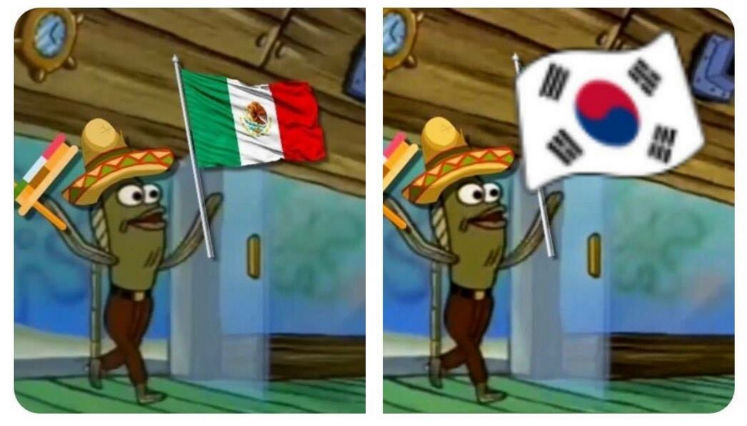
A moment in history. Best time to be on Twitter.
As the South Korean government continues to acknowledge their flash mobs and “good Mexican behavior,” there more Mexican youth (and, again, other K-pop fans in places throughout Latin America and the world) become engulfed by the cross-cultural Korean entertainment empire that’s been slowly creeping up under our noses.

 The Politics of K-Pop
Ivanna, one part of your blog post that resonated with me is when you discuss how the power dynamics between South Korea and Mexico manifest through fan work to implicitly prove their worthiness and to satisfy the South Korean government’s agenda. It would be interesting to see academic research measuring the intensity of fan work throughout Latin America over the years and compare these numbers to fans in South Korea.
Another element at play is, of course, the role of the South Korean government. As we have learned in class, the South Korean government has been pivotal in the rise of Hallyu and K-pop in the late 1990s and early 2000s after the IMF Crisis. The government’s continued role in K-pop can again be seen through the validating rhetoric of “good Mexican behavior” towards Mexican fans. Rarely, in the United States, do we view the government as a catalyst for powerful, emotional attachments to music and pop culture. Your example of how moved you were after watching the EXO-K cover of ‘Sabor a Mi’ in Mexico can be in part attributed to the South Korean government’s proactive outreach to the Mexican market. When we look at the immense popularity of K-pop across the world, it is truly amazing to think about how far-reaching the South Korean government has pushed its most popular export.
LikeLike
I love the emphasis on “worthy” in relation to K-Pop acknowledging countries outside of Korea. This concept of hierarchy between Korea and Mexico is interesting because I never thought of the presence of K-Pop in a foreign country as tied to a supply and demand system that is inextricably linked to power dynamics. This blog post suggests that fans are putting themselves out there to grab the attention of Korean entertainment companies, and there’s a sort of evaluation of “worthiness” by Korean companies to determine if it’s worth it to “send more groups” to these foreign countries. This form of evaluation reminds me of the way that locations are determined for K-Pop “World Tours.” It has become increasingly common for K-Pop artists to venture out of Japan and Korea when embarking on world tours, and many groups are now making stops in cities that were previously unimaginable: Dallas, Paris, Chicago, Toronto, Atlanta, San Jose, Madrid, Berlin, Minneapolis, Miami, and more (http://popcrush.com/2019-k-pop-concert-tour-festival-guide-tiffany-young-kcon/). In the past, a “World Tour” by a K-Pop group literally just meant East Asian and Southeast Asian countries, which is technically correct but fails to truly embody the essence of a “global world tour.” The fact that Korean entertainment companies are now dedicating efforts to booking stops in U.S., European, and Canadian cities show how the demand for K-Pop across the globe has risen. Which cities come out on top, or are worthy of investing in, however, are determined by the calls and actions of the fans.
LikeLike
Fans can feel absolutely blown away by receiving a reply on twitter from their favorite artists or someone they look up to. This takes it a step further to have an entire song be practiced intensely for them. It goes above and beyond. This shows the groups and fans putting in the effort that it was all worth it to make them “worthy.” However, as mentioned above, the Korean government seems to have a role in this whole ordeal. It could be possible they had plans to expand to certain countries by a certain time. To prepare for this they engage with the locals to plan these flash mobs and cover dances to be able to tenderize the culture with readiness to receive Korean idols. As much as it is a sweet gesture to Latinx and specifically Mexican fans, with it still being a business, there is room for some skepticism as to the motivations behind this choice.
This returns a bit to the Adorno and Fiske argument on whether these are organic fan driven processes, ones driven by the higher ups, or a mix of both. Regardless of which of these it is, it is a beautiful cover and a gesture which I also appreciate as a latina.
LikeLike
Similar to Stephanie’s comment, I wanna note the emphasis you place on worthiness. It definitely reminded me of a conversation we had in class about how Beyonce would never have to adopt to whatever country’s culture they were visiting/performing in, yet we some how expect KPOP idols to uphold that responsibility. With that discussion in mind, I think it’s interesting to think of how KPOP groups can be a good example of showing a degree of respect to the country being visited, even though ultimately the worth of that country is dependent upon the heads of the Korean entertainment industry and is hegemonic. Though I understand the reason idol groups visit countries beyond Asia relies heavily on the fans proving their loyalty and dedication to the group, I think there is no concrete reason for idol groups to put in that extra effort to learn a native song and sing it in their language. That labor is something that is additive. Their fans would still love the show even if they didn’t do that; however, them doing so means gaining an ever bigger respect and love from their fans and even non-fans. I definitely think there’s something that is humbling about idol groups taking the time to focus on a culture that isn’t theirs, despite Korea being a very homogenous country. Imagine Beyonce taking the time to learn another language and perform a traditional song in Japanese instead of just saying “konnicha Japan, genki desuka.” Fans go crazy when their favorite singer says hello in their native language, so to experience your favorite singer/group sing an entire song in their native language is a very powerful move that I think should be adopted globally.
LikeLike