The first time I learned about K-pop was in 2011. I was introduced to 2NE1’s ‘Hate You’ via YouTube. I thought the animations were cool and all, but I wasn’t that interested in it. Years later, I became curious about 2NE1 again and by then CL had done some solo projects. Again, I enjoyed the songs and music videos but there was something missing that didn’t make me believe fully in the power of K-pop.
Until 2016, when while scrolling through Facebook, I saw someone had re-posted a video of EXO-K performing a cover of ‘Sabor a Mi’ live in Mexico.
Let me break down my reaction process for you: 1) ‘Koreans singing in Spanish?!?!” 2) Koreans singing in Spanish in Mexico!?!??! 3) Koreans know of Mexican classics!??!
It was surreal. And like Erica Vogel suggests in her findings from her fieldwork exploring K-pop fandoms in Mexico City, it was realizing that a Korean group recognized Mexico and their cultural products enough to honor them with this special performance. It was understanding that there was a large enough audience of fans in Mexico for them to take the time to practice the pronunciation of the lyrics (which was, indeed, phenomenal). It was hearing the euphoria of Mexican fans when they recognized a familiar sound projected by idols that came from so far away.
And why did I care about Mexicans getting recognized by K-pop acts when I’m not even Mexican myself? Because it gave me hope that if they presented an interest in singing in Spanish, then they might become interested in other countries and cultures nearby. It mattered because I grew up listening to this song too (the version by Luis Miguel) and I felt connected to Korea via Mexico.
It was also, as Vogel put is, the idea of feeling worthy of their acknowledgement.
Key word: worthy. If Mexican fans (and fans from other places outside of Korea) must act and behave in a certain way to earn the attention of not just their favorite idols, but from Korean entertainment companies to “send more groups,” then there’s a clear hierarchy at play. As Vogel elaborates, competitions arise among fandoms from other countries close to Mexico to prove which is more devoted, worthy and organized (e.g. Mexico vs Peru or Mexico vs U.S.). These power dynamics between South Korea and Mexico, then, become manifested through these devoted fans who participate in unpaid labor to promote Hallyu and satisfy the South Korean government’s agenda — all for the possibility of having fleeting (online) interactions with their idols at most.
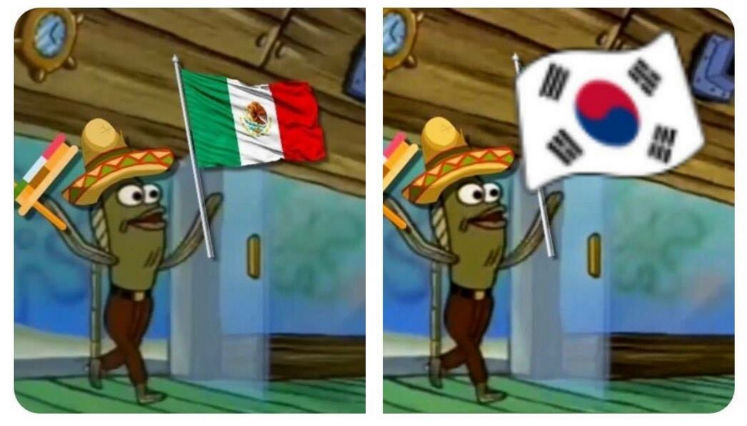
A moment in history. Best time to be on Twitter.
As the South Korean government continues to acknowledge their flash mobs and “good Mexican behavior,” there more Mexican youth (and, again, other K-pop fans in places throughout Latin America and the world) become engulfed by the cross-cultural Korean entertainment empire that’s been slowly creeping up under our noses.
 The Politics of K-Pop