When Youjeong Oh described the live production method of Korean dramas and the tight schedules and deadlines pressuring producers, actors, and editors, I was reminded of similarities to production schedules in Japanese anime and manga. For manga, such as those drawing weekly issues in Shounen Jump ie. Naruto, mangakas had to produce a chapter a week, which often resulted in a drop in quality and/or inconsequential arcs and chapters that don’t contribute to the longer story being told. The “plot change” influence of consumers on producers also reminded me of the Shounen Jump ranking lists which ranks the most popular characters in the magazine which in turn influences the manga artists in determining public approval of characters and the storyline thus far. In fact, massive public outcry at the last episode of the original run of Neon Genesis Evangelion pushed for the studio and Hideki Ano to produce a ending episodes that fit his original vision titled, End of Evangelion.

Neon Genesis Evangelion (1996)

The End of Evangelion (1997)
Additionally, unlike the general American media, Japanese anime and Korean dramas often put a lot of production costs into original soundtracks, as featured in the catchiest anime openings, and the most memorable Korean osts; I will never forget the first time I heard this ost in Goblin, and how much it brought together the whole episode and ending.
Another new phenomenon related to K-drama that I’ve noticed is the integration of Korean entertainment companies in production both in terms of providing actors and musicians. YG Entertainment started off producing k-pop idols but have since expanded to managing some of Korea’s most famous actors such as Lee Jong Suk, Nam Joo Hyuk, and Yoo In Na. Similar business expansions are seen in SM Entertainment and JYP Entertainment. Furthermore, singers and artists occasionally make their transition into acting such as Park Sooyoung from Red Velvet, Suzy from Miss A, and IU. Many sing songs featured in the drama as well. This integration and cross disciplinary strategy roots back to the skillsets acquired by K-pop idols, from acting to performance, through entertainment companies.
These integrations all service to the overall experience of K-dramas. K-dramas are no longer merely a consumption of images, but a consumption of images, audio, and lifestyle (when considering the advertising backers attached to the media through hallyu-hwa). Through selling fashion, beauty products, and lifestyles as those portrayed in K-dramas, audiences and purchase a tangible part of the imagined fantasy of those dramas. By adding an audio layer through memorable osts and music from the drama, the audience “do not remain within the framework of the drama; rather the boundaries of the drama, everyday life, and tourism are blurred” (Hirata 153). Such blurred frameworks of the drama bleeds out into everyday life through the diaspora and also through non-diasporic consumers into forming a globalized transnational fanbase that redefines the identity of k-drama culture and sensibilities within a global context. It’s the power of the k-drama branding and visual recognition that allows us to understand movie cuts like this scene from Thor: Ragnarok within a new context:
Such parodies and emulations of k-dramas through memes, reenactments in variety shows, youtube scene uploads, etc. are indicative of a new generation of consumption, of media being derivatives of each other in a constant cycle of regenerating, reintegrating media into new contexts and connections. Such reinterpretations are only possible with the advent of social media, and the recognizable dramatic branding of k-dramas allowed them to “[plug] into massive flows in the global media ecosystems” resulting in “its consumption in the United States finally and decisively [departing] from the marginalized ‘ghetto’” (Lee, 188). Once in this global consumption-production ecosystem, viewers can reinterpret media or pull traits and styles to emulate in other forms of media such as in the Thor: Ragnarok example.
Another point I want to touch upon is how legitimate K-drama streaming sites such as Viki, has integrated features from Japanese streaming sites such as Nico-Nico, namely the integration of scrolling/timed comments, or comments corresponding to and appearing at specific timestamps as indicated by the viewers.

Nico Nico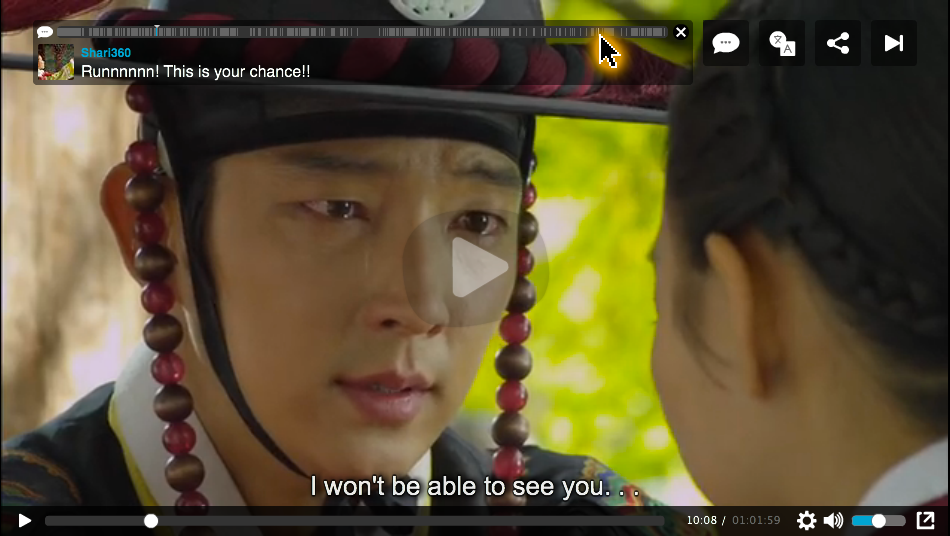
Viki
Such interaction between viewers forms a transnational global community between the consumers and highlights the quick integration of features of interactivity into k-dramas. Consumers can interact with k-dramas from whichever level they like, from either just leaving a comment, or fully immersing themselves in the addictive production.
This addictive production, however, though interesting and addictive stories are told and consumed, does raise concerns for me about freedom of expression and the diversity of critical stories; does the massive stake big business and government have in k-dramas limit the film team’s ability to tell groundbreaking, revolutionary stories? Is our global popcorn consumption and emulation of k-drama romantic values as admired by Japanese women highlighted by Hirata passive suppression of our sociopolitical concerns and criticisms of big business and government? I don’t have a solid answer to these questions yet, but as a consumer, I strive to be active in my consumption and the implications of what I’m watching.
 The Politics of K-Pop