The K-Beauty Influence

The Korean Beauty market is just one of the aspects of the current Hallyu wave which has exploded globally over the past couple of years. As people’s interest and obsession over k-pop idols and k-dramas increased, so did the desire to achieve the same aesthetic that their favorite actors and actresses donned regularly. Now, on many different social sites ranging from Twitter to Youtube you can find people in western countries raving about the fashion, makeup, and beauty aesthetic sported by their favorite korean celebrity. There are tutorials on how you can achieve these idealized looks and blogs which specify where k-idol’s clothes were bought from, and they’re endlessly consumed by a western audience.

When discussing the way the East Asian beauty standard spread to Vietnamese sex workers, Kimberly Huang discusses how Wonder Girls were idealized as an epitome of femininity. But the reasons behind why the beauty standards were adopted differ from those of a typical k-pop fan. Huang notes that “less developed Asian countries like Vietnam look to East Asia to represent modern cultural ideals.” When looking at this reasoning, it then begs the question why a western fan in a country just as developed as South Korea would also romanticize the beauty ideals and market of an East Asian country.
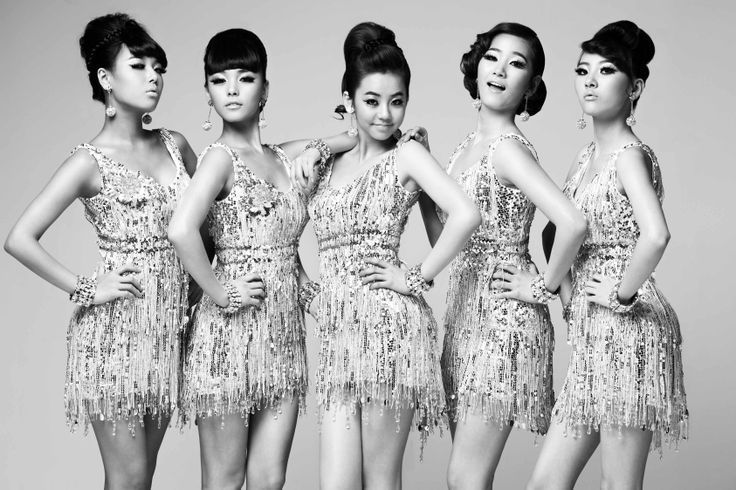
When I visited South Korea during spring break of this year, I was stunned by how strong the beauty standard was there. Almost every young individual I saw was following this template of beauty and fashion, and made anybody that deferred from it stand out even more. When discussing this phenomenon with my Korean-American friend, she brought up how she always felt slightly like an outcast when visiting South Korea because she didn’t follow these standards. It made me think about how many people conformed to a style of make-up and dress simply in order to fit in and be accepted by others in South Korea. And, furthermore, whether this desire to fit in extended to western fans of K-pop.

Even though they are physically far away from South Korea and the societal pressures present within the country, western fans still may feel a need to follow them in order to be accepted by a society and culture that they heavily idolize. Their love for a certain Korean celebrity may urge them to conform to what they believe the idol sees as beautiful, or even aspire to look like them, promoting a surge of interest in k-beauty. In this way, following the beauty standard of South Korea may make them feel more accepted into that community, and make them feel more similar to their favorite korean celebrity.

In theory, following a beauty trend is harmless, but when a beauty standard of another country is so heavily idealized, I can’t help but wonder whether it’s healthy for anyone, whether East Asian or not, to feel the need to conform to a certain aesthetic in order to feel accepted.

The Kim Sisters, Seo Taiji and Boys, and the characteristics of K-pop today

If someone were to ask where they should look in order to understand the origin of K-pop, many people would direct them to the iconic trio of Seo Taiji and Boys. Debuting in 1992, this group was arguably the first to create music completely different from what was in the Korean music scene today, pulling influences from the west to create a foreign sounding song about South Korean issues. In some regards, this would be the correct answer to their question. When looking at K-pop today, there is no other group that fully shows the birth of a music genre which has taken over nationally and globally. Seo Taiji and Boys were the first to take western music influences, such as R&B, hip-hop, rap, jazz, etc., and use them to create a new hybridity of music, which appealed massively to the younger audiences. This hybridity, combined with their colorful visuals, eclectic fashion, and big dance moves, is a big fundamental of K-pop today, making Seo Taiji and Boys a prime example of K-pop’s beginnings.

Seo Taiji and Boys performing “Come Back Home”, live on MBC in 1995


However, many people would forget to direct them to a different trio that may show just as much of K-pop’s beginnings as Seo Taiji and Boys. This trio is the Kim Sisters, three young girls who performed music in South Korea for American Soldiers during the Cold War. Formed in 1954, the Kim Sisters first began to perform for GIs that were stationed in South Korea by the American army during the Korean war, performing songs for them in night bars. The girls were young at the time, ranging in ages between 11 and 13, but they garnered an extensively large amount of attention and popularity among the soldiers, which was just one example of a larger trend taking place at the time: a rise in popularity of all-Asian girl bands. The girls ended up having such an impact among the GIs that they were able to perform in America, even on the Ed Sullivan show in 1959, performing songs, mainly all in English, that showed off their singing abilities, and wearing western outfits that showed off their figure.

The Kim Sisters performing

The Kim Sisters were very talented, and their performances contained many of the elements that even Seo Taiji and Boys followed, including some dancing and songs influenced or taken from the west. In this way, their group shows an origin of modern day K-pop, albeit in a more diluted manner than Seo Taiji and Boys. The success of the Kim Sisters performing on The Ed Sullivan Show is a good example of the additional cultural exchange that took place during this time period, since it shows their success in presenting the American television audience with a foreign group. But even more than that, the success of the Kim Sisters with the American GIs showed a different aspect of their popularity which may still be present in K-pop today.

When the Kim Sisters began to perform in Korea, one of the reasons they became so popular, even though they were very young, was because of the fetishization of young Asian girls and women at the time of. Because of America’s troops stationed abroad in Korea, there became an increasing amount of sexualization of the Asian female figure due to the prostitution and interracial romances which occurred there. This is a sad reality for the all girl group, but one which can hold true even in today’s K-pop. As K-pop began to grow past Seo Taiji and Boys, the artists began to be idealized by their fans, even going so far as to have artists in the K-pop industry be called idols due to the way they were romanticized by their fans and put on a pedestal. Especially as K-pop becomes more global, a resurgence in the sexualisation of the Asian figure is growing as well. This is another fundamental that was first seen with the Kim Sisters, and one which is just as much apart of K-pop today.

The Kim Sisters and Seo Taiji and Boys were two very talented groups that contributed a lot to the Korean Music industry, and more specifically the K-pop industry, and although what their groups and their success provided were different, they both became important examples of K-Pop’s beginnings, and the fundamentals and characteristics, both positive and negative, that were created by them which are still a big part of K-pop today.