Racial Plagiarism and Hybridity: According to Black Twitter

Twitter is a battleground for Black and non-Black KPop fans alike to engage in debate about idol hairstylists’ choice to appropriate traditionally Black hairstyles as performative aesthetic. EXO’s Kai, for example, has a history of wearing dreadlocks in ‘Wolf’ and “Ko Ko Bop”. While the style was likely handed to Kai for EXO’s early “Wolf” comeback, it has been alleged that he specifically asked for the dreadlocks for their summer 2018 comeback, “Ko Ko Bop”, a time during which reggae aesthetics and musical styles became a trend in KPop.

This tweet that had me cackling:

Black and non-black fans online argued that Black folk in America face racial and economic exclusions due to their natural hair and yet, Korean idols are able to temporarily use the styles for the opposite effect of capital gain and popular success both trans-nationally and locally. This is a situation that reads much like American celebrity, Marc Jacobs, as Pham exemplified in Racial Plagarism and Fashion.

Black KPop fans arguing from an American political perspective about Korean socio-politics is a complex case in and of itself. Joel Lee articulated my exact thoughts before I could, so I’m just going to refer to his article, Qipaos, Hip-Hop, & Hybridity. Lee says, “At the same time, Anderson’s argument hybridity allows for the K-pop to exist without the binary of what is authentic and what is not based on U.S. racial politics. K-pop use of black aesthetics, especially with Big Mama, show the transnational capabilities of music. As Anderson argues, the music is created in context to its absorption of outside material and create new material. Therefore this allows for K-pop to have an authenticity without being strictly defined by the U.S.A.”

In these debates, fans arguing against the appropriation of Black hairstyles on idols labeled the situation a case of “cultural appropriation”. I believe those in favor of, or indifferent to, idols wearing Black hairstyles used the inarticulate language of appropriation in turn, and labeling it “cultural appreciation”, to avoid addressing the political and social ramifications that are at the heart of the former fans’ arguments.

Pham points out that the appropriation/appreciation emphasizes “individual feelings, intentions, and uses rather than structurally contextualized practices”. Pham says, “Cultural appropriation/appreciation blurs crucial dynamics of power that, though they may be linked, are the not the same, particularly the difference between the impositions and negotiation of power and the difference between racist representations and racial capitialism.”

What Pham says about the linked, but non-similar dynamics of power in racial plagarism reminds me of when Jay Park equated non-Blacks wearing dreadlocks to non-Asians listening to K-pop music.

This is another tweet about the incident that also had me cackling:

Jay Park did admit in his Instagram rant that he was unclear on what qualified and disqualified as cultural appropriation, given its vagueness. Moving forward, I believe using Pham’s “racial plagiarism” as a more accurate framework in cultural discourse online will prove to be much more productive.

It G Ma: Cultural Appropriation or Appreciation?


This week’s reading theme is “Cultural appropriation or appreciation?”. As a MCC student, this question has been discussed many times in multiple classes. However, I have never considered the question in particular to “K-Pop” and Hallyu so it was interesting to think through this particular lens.  Everytime this question has been discussed, my question has always been, “Then what is original?” “What isn’t cultural appropriation?” “ “What constitutes “appropriation” of culture?”. In my perspective, appropriation can be either be done well or bad. It can be either cultural appreciation or cultural misappropriation.
Thinking about cultural appropriation through the K-Pop lens, the first thing that I thought of was a controversial song called “IT G MA” by a Korean rapper named Keith Ape. When this song was first released in 2015 it received a lot of mixed reviews globally, as some western listeners accused Keith of severely appropriating the black hip hop culture, some praising Keith’s ability to adopt another culture as his own, and some listeners downright calling the song and the tune messy and everywhere. Personally, when I heard this song for the first time, I thought it was just another western rap music. In my personal opinion, I don’t think “IT G MA” is a imitation of the southern black hip hop culture. I don’t think Keith Ape made the song with the intention of appropriating the southern hip hop culture because he thought it was “cool”, but rather a personalized interpretation of a style of music that is widely pervasive and popular. If you watch the music video of his song, there are small elements of appropriation happening from the African American rap scenes, though I don’t think it to be a bad thing. In my opinion, I don’t think appropriation of culture is a bad thing. Culture travels globally and appropriation can be regarded as the highest form of flattery. With the rise of the internet world, the connectivity of the world has become so close and fast. The practicality of outreach has become so easy and accessible. And if we don’t share and gain inspiration from other cultures, fashions, trends, personalities, and music, then what is the point of all this connectivity? I think 21st century is all about modernity and innovation. We need to be exposed to experiences, people, and trends to continue to make our society exciting and new.
However, I do believe that there is a fine line between culture appropriation and appreciation. Personally, I just don’t know what that line is. What are your opinions?

Diary of a Black Fan

I have to begin this post by stating I am a 22-year-old black man. I have been a fan of K-pop and Korean culture since I was 14. Over the last 8 years, I have had my ups and downs while navigating the Korean music industry as a black body. The themes of appreciation V.S.  appropriation have come forward since the inception of K-pop in my life. For an extended period of time, I ignored the signs of appropriation in K-pop because most the fandom would shun me or even outright threaten me for speaking out against their “bias” or their favorite group. This made engaging with the topic not only extremely hard but draining as well.

The co-opting of black culture for views and engagement can be seen countless times throughout most of K-pop especially in music videos. This can be the use of black fashion, styles, trends, and culture sole for monetary gain. It’s literally engaging with a group of people/ their culture only when it is beneficial. CL’s song Baddest Female is a great example of an idol and entertainment company capitalizing on black culture for views.

CL’s video has a late 90s and early 2000s female rapper/ R&B singer vibe. The themes of the video were also very interesting especially since it is a song that seems to be promoting female empowerment. The video highlights many fashion trends and themes that were prominent in the black community during the late 90s and 2000s. When first watching the video I noticed the accessories more than the outfits even. There was a heavy emphasis on the gold chains she was wearing, her grillz, and flexing her money. These are also themes that can be found in many different hip-hop music videos as a way to show that one has made it out of their struggle and to a point where they can show off what they have. Showing this growth in wealth and change in environment is why rappers often emphasize their bank accounts, whips, and homes in music videos. For many fans who are engaging they can claim that she is doing the same thing that many have done before her. However, this baseline engagement with hip-hop for an aesthetic promotes an unhealthy surface level engagement with black culture in general.

CL is not the only example of this within Korean hip-hop. Truedy is another Korean hip-hop artist who also capitalizes on black culture. With her, it is much less subtle than it is with CL. Truedy in her everyday appearance can be seen rocking braids, chains, and timeless 90s and 2000s “hip-hop” styled clothing. She uses her aesthetic to fit the mold of what it means to be a rapper/hip-hop when in reality there is no clear cut design.

Truedy in 2015

This brings me to Pham’s piece and the term racial plagiarism. This was a term prior to this reading I had never heard of. “Racial plagiarism” accord to Pham “centrally involves and colludes in racial capitalist processes of value extraction in which racialized groups’ resources of knowledge, labor, and cultural heritage are exploited for the benefit of dominant groups and in ways that maintain dominant socioeconomic relationships.” This idea is meant to give a fine line to the debate between cultural appropriation and appreciation, which can be extremely vague and leave too much up to interoperation. Although in many ways this idea of racial plagiarism also leaves room for work too. Ignoring that, if these guidelines are applied CL’s music video it can clearly be seen that highly popular female artist is racially plagiarising. Although she is a Korean woman and is part of the minority her actions of co-opting black hip-hop culture for her company’s and her own beneficial gain feeds into the hegemony established by white bodies. By using the fashion, trends, and styles black bodies created to seem more hip, edgy, and gain views while simultaneously ignoring the cries of black fans doesn’t seem right to me. The same can be said for Truedy and many more artists. Maybe feelings should be excluded when discussing racial plagiarism however, that doesn’t sit right with me either. If an entire group is asking for change or actively saying there is a problem, maybe it’s time to listen.

Can Korean artists claim R&B and Hip-Hop?

I am very interested in the effect that music can have on the interaction between different communities, especially within the context of hip-hop and R&B, as there is a lot of give and take (both acceptable and unacceptable) between the African and Asian diasporas.  Crystal S. Anderson’s Hybrid Hallyu: The African American Music Tradition in K-Pop focuses on questions of cultural appropriation in K-pop artists’ use of elements from hip-hop and R&B.

“The 1980s and 1990s witnessed a shift from the repressive regime of Park Chung Hee, South Korea’s last dictator, to a more democratic and culturally tolerant environment ushered in by Kim Young Sam in 1992. Rhythm and blues and hip-hop represented musical traditions that spoke to the creative possibilities opening in Korean society” (292).  The shift to R&B and hip-hop seems somewhat natural to me, as I understand songs from both genres to (usually) generate from real-life experiences of suffering and oppression.  In thinking about how artists often use creative expression to speak out against their respective societies, I thought about the 2004 song “Dear America” written by Psy and N.E.X.T. which has very anti-American lyrics related to war.  In a CNN article, Psy said the song “was part of a deeply emotional reaction to the war in Iraq and the killing of two Korean schoolgirls that was part of the overall anti-war sentiment shared by others around the world at that time.”  According to the article, the girls were struck and killed by a U.S. military vehicle.  https://www.cnn.com/2012/12/07/showbiz/psy-apology-irpt/index.html

Much like how the debut of groups like Seo Taiji and Boys heavily contrasted “healthy songs,” I can imagine the emergence of Korean R&B and hip-hop to be considered “rebellious” at the time, especially within the context of a post-dictatorship society.

While the development of hip-hop and R&B in Korea (and other communities) seems natural, I find the execution of it questionable at times.  As he is one of the only Korean artists I know of, I will use Dean as an example.  Dean’s single “love” (feat. Syd of The Internet) “sounds” very R&B:
https://www.youtube.com/watch?v=SkNB5AsgZOc&ab_channel=COLORS

“Rhythm and blues and hip-hop are black musical genres, not because of who performs them, but because the genres themselves contain elements that reflect black aesthetics” (291).  I personally do not see any obvious cultural appropriation in this song, especially because it is a collaboration between Korean and African American artists.  I often feel that a song’s meaning and/or the artist’s intentionality behind the song can signal cultural appropriation, like in the current case of Ariana Grande and her newly developed sound / aesthetic.   Dean’s lyrics and performance are universal, so I do not think his existence as an R&B artist is a problem.

In the reading, Anderson states: “Similarly, the authenticity of Korean artists’ use of hip-hop is measured by how closely they conform to a U.S.-based hip-hop defined by discrimination and racism” (294).  Is this just because United States society is more diverse and might consider discrimination like racism more than Korea?  Additionally, I would like to further explore the topic of diversity and originality in K-pop (and music in general), as I have been interested in these topics for a long time and am also taking a class called “Afro-Asian Cultures” which considers the interaction between the African and Asian diasporas.  In the dance community, there is a parallel debate about the use of the term “urban” when describing dance styles, as the term does not credit the origins of moves/styles and therefore can be considered an appropriation of the dance style’s culture.

Qipaos, Hip-Hop, & Hybridity

What is clear from the readings this week is that music and culture is not created in a vacuum; it is inextricably tied to the relationship between nations and the market and how they reflect changes throughout history. As Doobo Shim and Minh-Ha Pham point out, the reduction of censorship and the opening of the cultural industry allowed for creative experimentation and the exposure of black musical aesthetics.

When Pham refers to the politics of hair and its erasure in the Marc Jacobs show, it reminded of two incidents of racial plagiarism and stereotyping through hair color in recent history. When Keziah Daum, a non-Asian teenager posted on Twitter her qipao dress for prom, Twitter went ablaze. Daum’s wearing of the dress is another form of racial plagiarism as it reduces the dress to a cultural commodity free to be interpreted an “appreciated.” She wrote in a response on Twitter:

“I mean no harm. I am in no way being discriminative or racist. I’m tired of all the backlash and hate when my only intent was to show my love.”

This falls on the same binary that Pham writes –– that the argument of cultural appreciation gives too much weight to the “intention” of the appropriator and reduces the critics as “snowflakes” or too sensitive to issue. What bothered me more in context to the Daum’s dress was the angle that NYTimes writer, Amy Qin, decided to write about it. I understand as journalists unless it’s an op-ed, it’s important to get both sides of an issue. However, as a reader, I felt that Qin emphasized the mainland Chinese opinions on Daum’s dress in her article.

Many of the quotes used in her article emphasized that mainland Chinese see no problem with Daum’s dress and have a sense of cultural pride in her wearing of it. More weight was given to the overseas opinions about the Daum’s dress rather than contextualizing Daum’s dress within racial politics of the U.S. The article read as a reaffirmation that mainland Asians gets to have the final say on what is appropriation and appreciation because of the underlying notion that they are “purely Asian.”

Another point of contention of Daum’s dress was the group photo of her and her non-black peers in a “squad” pose that is rooted in black aesthetics. Some Twitter users felt more enraged by the squad pose than the dress because it clearly appropriated the “squad” pose that was created in black culture through social media –– Daum and her peers wanted to capitalize and create a sense of “coolness”, “being real”, and the tight bond among friends that the aesthetics portray. The entire fiasco can be seen as a double-edged crime. Not only did Daum racially plagiarize a qipao dress to “appreciate it” but also her posing of black culture further the cultural deafness of her and her peers.

This leads me to the concept of hybridity and authenticity that Crystal S. Anderson argues. When I read her piece, I thought about other rappers who have been put into the hot seat for using black aesthetics. Eminem is a prime example of this. Many consumers and critics if Eminem is imitating black musical traditions and if he is allowed access to hip-hop and rap as a white man. What from I know of the general progression of Eminem, consumers respect him because his personal narrative seems authentic and derives from a sense of “being real” that Anderson mentions; however, there is criticism that must be taken into account about white rappers.

In the same light, K-pop is not exempt from criticism about the appropriation of black culture. At times, the overuse and pervasiveness of the required rap verse in K-pop are overused and formulaic and falls into the notion that rap automatically gives a “cool” factor” to a song and can be seen a musical commodity rather than a verse with intention.

At the same time, Anderson’s argument hybridity allows for the K-pop to exist without the binary of what is authentic and what is not based on U.S. racial politics. K-pop use of black aesthetics, especially with Big Mama, show the transnational capabilities of music. As Anderson argues, the music is created in context to its absorption of outside material and create new material. Therefore this allows for K-pop to have an authenticity without being strictly defined by the U.S.A.

Still, the importance to recognize K-pop’s hybridization and use of black culture and musical tradition must be a narrative that is recognized and understood when consuming K-pop.

K-Pop and Power Dynamics: Where Do They Lie?

Cultural appropriation is unfortunately nothing new to the K-pop industry. From traces of Black hairstyles found in K-pop acts here and there to the superficial wearing of traditional garments, K-pop’s globalized nature makes it prone to more and more instances in which cultural aesthetics are utilized for profitable purposes, making idols prone to more and more criticisms by international fans.

Unfortunately, cultural appropriation itself has been around since even earlier, as exemplified in “yayaya” by T-ARA (released in 2013), which features the members partaking in stereotypical portrayals of Native American culture and practices such as war cries.

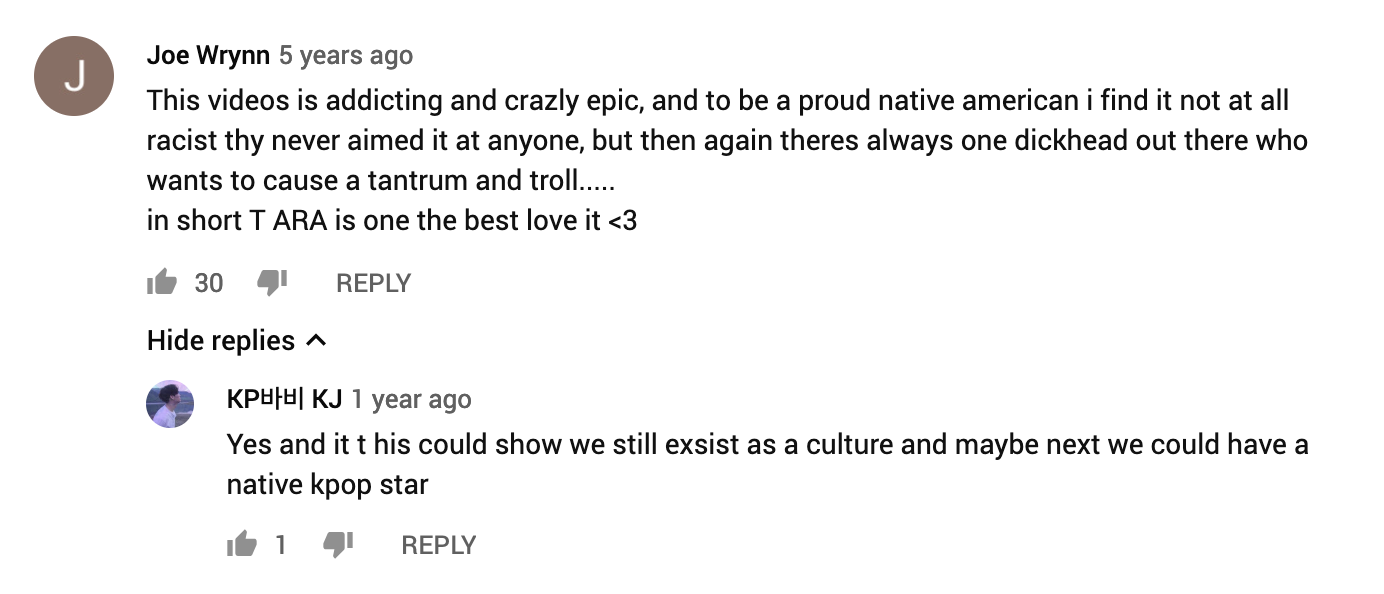
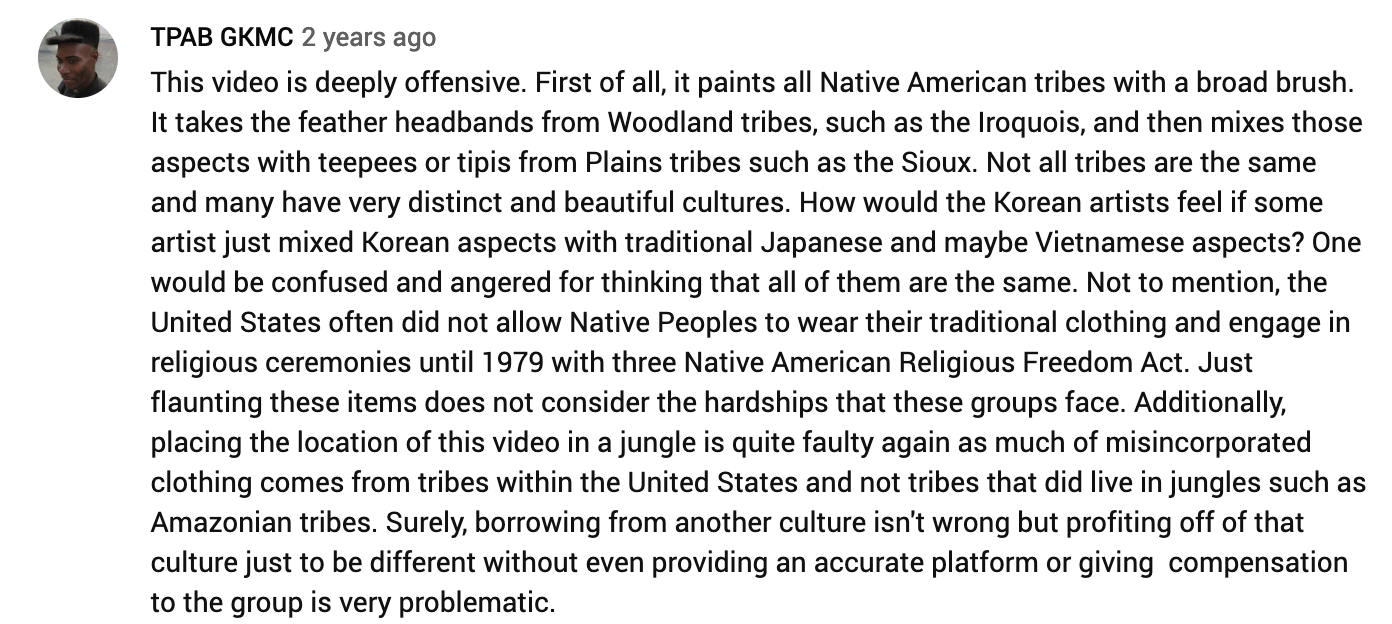
The comments below the YouTube video unsurprisingly have people (Native American and otherwise) taking sides as to how they feel about the portrayal of the Native American caricature in the video.Screen Shot 2019-02-23 at 4.43.59 PM.png

Certain viewers mention how the accuracy of these portrayals are painted in broad strokes (one commentator mentions that T-ARA are taking feather headbands from Woodland tribes but also incorporating teepees/tipis from Plains tribes) while other expressed a level of gratitude for the video showcasing the continuing existence of Native American culture, with one viewer suggesting, “maybe we could have a [Native-American] kpop [sic] star.”Screen Shot 2019-02-23 at 4.44.09 PM.png

This is the issue with the cultural appropriation vs. cultural appreciation debate that Pham points out: the term “cultural appreciation” itself prioritizes the “feelings” or “good intentions”. It is because there is so much emphasis placed on how viewers “feel” about these certain portrayals — whether they find it either amusing or offensive — that these debates often fizzle out into nothingness as nothing more than a “let’s agree to disagree” situation, which is why Pham asserts that we move on to calling this sort of practice “racial plagiarism.”

What Pham interestingly points out is that “racial plagiarism” involves the process in which “racialized groups’ resources of knowledge, labor, and cultural heritage are exploited for the benefit of dominant groups and in ways that maintain dominant socioeconomic relationships,” with “dominant groups” primarily related to White people. I wonder where Koreans fit into this equation: are they still considered to be part of the dominant groups which render these actions as “racial plagiarism” or does their status of being an ethnic minority give them some degree of leniency? Where does South Korea, a country so often situated outside of these conversations on racial inequality in America, fit into with these power dynamics that are also apparent in Western civilization in its entirety as well?

Break up with your culture, I’m bored.

While reading this week’s texts, the first thing that came to mind was white, Italian artist Ariana Grande’s long list of questionable actions of late: a gradually darkening fake tan, queerbaiting (the practice of hinting at a same-sex relationship, usually done for sex appeal) in the music video for her single “break up with your girlfriend, i’m bored,” use of Japanese culture and characters as a “trend” in her music videos as well as an unfortunate mis-spelling of “7 rings” as “Japanese BBQ finger” for a hand tattoo and blaccent (the imitation of the way that those who are Black speak, of which is appropriative). As a fan of hers—which I’m not entirely sure if I still am—it’s been incredibly disappointing and frustrating to watch.

Much like Miley Cyrus’s short-term adoption of Black culture for her Bangerz album concept,—in which Cyrus picked up twerking and grills to incite a “shock factor” at her 2013 VMA’s performance and be “trendy”—Ariana Grande has monetized off of a culture that isn’t hers. As straight, white, U.S. citizen, upper class, and cis-gendered females, artists like Grande and Cyrus have the privilege of choosing when they’d like to be “Black” and when they’d like to be “White,” or in Grande’s case, when she wants to be straight and when she wants to be lesbian, something that those who come from/identify with these cultures do not have the ability to do. This is where I believe the problem with appropriation lies. Culture isn’t a costume that’s worn for a season and then can be thrown away; it’s a way of living, an intimate sense of identity which belongs to a community that is often discriminated against by White persons like Grande or Cyrus. A superiority complex is developed by those who appropriate, because they can take on the parts of a culture they like and deem “cool,” leaving what’s left as negligible and unqualified. 

Unfortunately, in K-Pop culture, that same appropriation is explicitly present, most commonly through the wearing of dreads or in a more serious situation like MAMAMOO’s case, Blackface. The gray area, however, lies in other parts of Kpop culture, like its music, which is informed by genres such as R&B, jazz, and Hip-Hop, all genres which have been created by Black artists. But before deciding which side of the appropriation-appreciation scale Kpop culture tilts towards, I agree with Doobo Shim’s argument that although “Koreans have emulated and appropriated American cultural industries with ‘Learning from Hollywood’ as a slogan…Koreans have provided their own twists to the foreign styles and forms” to create the hybrid that is Kpop culture (Shim 37).  What makes K-pop Korean is what makes it different from American Urban pop; Koreans have not claimed R&B or Hip-hop as their own, which enables K-pop music to generally stray from appropriating Black culture. There isn’t an imitation, rather, there is innovation built from the creation that is rightfully owned by Black people. I think a good example of this is the song “IDOL” by BTS, which incorporates traditional Korean music and dance with production that derives from current American popular music (i.e. member V’s use of the vocalization “brrruh” with heavy autotune, a popular trend in trap music today).

But when exactly can we say something is “appropriating” culture? Minh-Ha T. Pham’s substitution of “racial plagiarism” for cultural appropriation is, “a more precise formulation for [the] kinds of practices of unauthorized and uncredited…copying” (Pham 68). Plagiarism can be definitively proven, whereas the term “appropriation” leaves room for subjectivity.

With the development of the new and improved lens that is the term “racial plagiarism,” I think it’s become even more imperative to try and educate others on why it’s harmful to racially plagiarize and how this plagiarism has and continues to occur, especially because in countries like South Korea, the offensive activity stems from ignorance, rather than malice. Although still problematic, the lack of education largely contributes to the perpetuation of such appropriation. Innovation is how a society develops, and I do not believe that building on foundations is wrong, nor that it implies that these beginnings are owned by those who fuse it with their own culture; what’s important lies in giving credit where credit is due, and understanding that plagiarism, no matter how insignificant it may seem to those who practice it, is still, taking what isn’t yours, and claiming it as your own.

Beyond Capitalist Pessimism and the Culture Industry

An aspect of advertising and its relation to Korean pop culture that I’m particularly interested in is the advertising shift from product to melodramatic expression and value sensibilities reflective of the capitalist. The melodramatic justice that is described by Federenko is often present in Korean dramas such as “While You Were Sleeping” and “City Hunter” where a sort of cosmic justice seems to realign the world by the end of the story and provides cathartic release for the viewers. This similar display of moral order appears in a new form of advertising that fuses aspects of moral justice, old forms of informational advertising, and entertainment in advertisements such as Dingo K-beauty’s advertisement for nose and cheek pore masks:

This type of advertising is overt in its product promotion, and links the product to upholding liberal, progressive social values to beauty and cathartic justice. These advertisements would be significantly less effective if they merely focused on one aspect of this multi-pronged narrative. Rather, it fulfills multiple functions for the consuming viewers within the capitalist, democratic system, and reassigns “advertising content … with lived realities, making them communicable and thus empowering those experiencing them” (Federenko, 44).

This sort of lived reality is blurred further when CF personalities are often cast as parallel versions of their real selves. An example of this is when Irene from girl group Red Velvet reenacted a reaction she had during an album promotion in a commercial deal.

Another is when Etude House promoted their lip lacquer with Red Velvet singing the baby shark song, a song personally enjoyed and parodied by the members and their fandom prior to the commercial deal.

In these commercials, we see the lived realities of idols that became repackaged for advertising and promotion of products. I would further argue that these commercial deals capitalize on the fan loyalty to idols and aim to make their fans a big portion of their market base. For those who are not familiar to what the advertisement is referencing, it may appear as just another quirky form of advertising similar to the olleh! campaign. But, for those who are deeply intimate with the fandom of these idol groups, the reference to the original “source material” aka, the lived realities of these idols and their interests, incites brand loyalty and association between the fans, the idols, and the products, as if bringing in the consumer into the exclusive lives of popular idols and their day to day products.

This new form of advertising doesn’t upheave the standardization of capitalism and the culture industry though. As Adorno and Rabinbach puts it, there is a “disguise for an eternal sameness; everwhere the changes mask a skeleton which has changed just as little as the profit motive since the time it first gained its predominance over culture” (Adorno and Rabinbach, 14). These new elements of advertising aren’t meant to change the capitalist system in which they operate, but rather, it capitalizes on our changing society’s demand for new forms of advertising, media, and entertainment. Though I believe that these advertising forms still have to meet the function of the capital, the connection and relevancy they form with mass culture transcends the capitalist intent, and finds itself “fondly mentioned in the sociocultural histories … and reposted by nostalgic bloggers” (Federenko, 350).

This cultural value is immeasurable by the standard valuation of capitalism and the culture industry, and I believe, it points towards a future of increasing weight placed on relevancy beyond capitalist intentions. The connection viewers of advertisements such as to Red Velvet’s insider references, or Dingo’s comedic product promotion, speak to a new valuation for entertainment beyond product purchases, and is more akin to cultural indulgence in aesthetic and narrative sensibilities of these simulated lived realities. The lines between the simulated and the real, the idol and the fan, the production and the consumption, are blurred in these interactions leaving traditional valuations incomplete at best, and deeply cynical at worst.

Translation, Subtitles, Culture

I recently learned about Viki, a site that hosts Korean dramas many of which, if not all, are translated from Korean by international fans. In an interview on Kultscene, two volunteers that subtitle and segment Korean dramas without pay talk about many of the trademarks of of Hallyu. User Bjohnsonwon describes the pride they have to be part of a community that makes Korean dramas more accessible to larger audiences. In particular, there is a sense that the Viki community works together as part of a larger project, similar to how fans of BTS have created an imagined community like BTS ARMY. Beyond the Viki community however, there is also the idea that Korean dramas are a source of pleasure that should be translated for transnational audiences to consume.

The dedication that the fans have for the dramas becomes apparent not through the amount of labor that Viki users volunteer. Bjohnsonwon describes how the turnaround time for translating ‘Pinocchio’ was at most 24 hours, a feat that requires coordination of multiple users of different skill sets and language capabilities. The success of their unpaid labor seems to be an exciting example of how we can create effective community organizations without the coercive oversight of a corporation or government.

This idea, that the laborers can organize amongst themselves without being subject to a rigid hierarchy, seems to complicate Adorno’s formulation of the culture industry. Instead of “integrat[ing] consumers from above” like Adorno argues, the consumers can organize without integrating at all (Adorno 12). And in the case of the role of fans like Bjohnsonwon, Adorno would argue they are objects of the culture industry. I take this to mean that the Korean culture industry has, intentionally or otherwise, created the conditions that would convince fans to contribute and translate their dramas.

The willingness of the consumer to contribute their labor seems to fit into Adorno’s model. Without knowing a lot about Korean dramas, Korean dramas seem to be “tailored for consumption by the masses” (Adorno 12). Korean production companies probably plan to have large transnational audiences without having to provide the labor of translating their dramas. User contributions are expressions of individuality, for example when Bjohnsonwon expressed pride at knowing that they had “a small part” in seeing a drama’s rising popularity. However, the labor that users provide is mostly interchangeable, translation and segmentation can be done by any other user to largely the same effect. This belief that the labor users provide can somehow be unique to the individual, like when users choose funny sub-team names, is what I believe to be the ‘conformity’ that replaces ‘consciousness’ that Adorno describes (Adorno 17). Users no longer willingly provide labor by conforming to the expectations of the community to contribute for the greater good.

On the other hand, the power to subtitle and translate offers fans space for subversion. If Adorno suggests that the culture industry ultimately serves to prevent individuals from acting autonomously, then Viki would be a bad example. The very nature of the labor that users provide is autonomous and independent because it is unpaid. It seems like Fiske’s model of the two interdependent sub economies can explain these differences. The Viki translator is a consumer, while also literally a producer of meaning. As a result, the “producers and distributors of a program can exert some, if limited influence….over the meanings and pleasures of the audience” (Fiske 540). Consumers have power to decide what shows succeed during the time that Fiske writes, but translators for Viki for further by having the power to decide what the characters even say.

I’m interested to understand where sites of resistance and subversion may appear in Korean dramas. It seems to me like the culture industry is not strictly top-down, nor is it totally homogenizing. However, I do not currently understand the extend that subtitling has to be subversive. That’s not to say that I believe the Korean culture industries lack sites of resistance. Holland’s music examples could be one example of resistance through consumer interpretation…


Korean CFs and Sex Appeal

Korean Commercial Films, CFs for short, have long targeted consumers through consumer-centered marketing. They focus on creating a cultural experience for the viewer, as opposed to simply trying to sell the commodity that it is trying to advertise. These CFs go beyond the product and, instead, attempt to engage with the consumer through the experienced realities and everyday lives of the consumer themselves.

As discussed in previous classes, the phenomenon of hallyu-hwa has led to the integration of hallyu into seemingly unrelated industries, whether that be water heaters, cars, or even banks. But there is no industry more reliant on Korean celebrities and idols than the Korean advertising industry. As Olgo Fedorenko puts it in the chapter “South Korean Advertising as Popular Culture” in the book The Korean Popular Culture Reader, advertising has “morphed into entertainment” (357).

One of the three main aspects Fedorenko discusses is the use of sex appeal and commodity aesthetics in advertising. On my first trip to South Korea in high school, I distinctly remember sitting in the hotel room, flipping through the TV channels at night. On one channel came a commercial for the soft-drink Sprite, featuring Korean model and actress Clara Lee.

In the advertisement, Lee walks onto a beach party in a bright green bikini swimsuit, presses a lever on a giant soda fountain system, and proceeds to take a shower in Sprite. The viewer is shown multiple shots of Lee’s body glistening in Sprite. Male party goers and the lifeguard look onto Lee in amazement, one man even spitting out the Sprite from his mouth at Lee’s beauty. Lee proceeds to turn to the crowd of men and ask, ‘Will you shower with me?’. The beach party is a huge hit and the crowd has a good time dancing and showering in Sprite.

This advertisement was so jarring to me because, prior to coming to Korea, I had developed the impression that Korea was very conservative and not as reliant on sex appeal in their advertising as Western countries. What I hadn’t realized at the time, was that “media liberalization [had] created a more permissive climate for media expression” (Fedorenko 354) in Korea. Seeing a CF that was so vividly painting a picture of Lee as the token attractive woman with a great body, asking men to shower with her in Sprite, was very surprising. This CF, in addition to selling Sprite, was meant to be consumed as a cultural product. While the commodity itself (Sprite) “remained in the background” (Fedorenko 348), the focus was more on the liberalization of the “social norms about sexuality” Fedorenko 355).

Another CF that I came across recently stars Sohye of girl-group IOI.

In ASMR style, Sohye talks to the viewer by breaking the fourth wall. She whispers:

“Hey Oppa, this summer, I’m making you samgyetang [Korean chicken and ginseng soup] so that you don’t get exhausted and grow rapidly. Eat this and you have to grow. A summer package that will help coach-nim to grow rapidly”.

In a similar fashion, two other versions of the CF feature Sohye preparing a watermelon and ssam [wraps] for ‘coach-nim’, aka the viewer. The commodity the CF is trying to sell? FIFA Online, an E-Sports online gaming platform. This is one of the most typical examples of the commodity remaining in the background and sex-appeal being at the forefront of a CF. Through the CF, Sohye talks in a very cutesy tone, referring to herself in 3rd person and using very timid gestures and expressions. She repeatedly refers to the viewer as ‘Oppa’, a term of endearment used by females to refer to older men, whether that be older brothers or a boyfriend, etc. The CF resonates with the idea that Korean girls are very cute, submissive, and take care of their Oppas. The CF has seemingly very little to do with FIFA  Online itself, but it targets the Korean male viewer’s reality of the desire to have a cute girlfriend or little sister just like Sohye.

It is evident that Korea has moved far beyond the state of advertising it had in the early 1990s when CFs still portrayed the conservative societal views and media censorship. With the emergence of hallyu-hwa and the Westernization of Korean society, we see a greater reliance on Korean celebrities and liberal modes of expression such as sex appeal in the marketing tactics used by agencies. I firmly believe that as Hallyu continues to spread throughout the rest of the world and Korean CFs, like K-Pop music and K-dramas, increase their reach, these advertisements will become increasingly Westernized so that even more international fans of K-Pop start to consume Korean products such as samgyetang and E-sports platforms such as FIFA Online.

Works Cited:

Olga Fedorenko, 2014, “South Korean Advertising as Popular Culture,” The Korean Pop Culture Reader, 341 – 62.