For years, Asian men have had their masculinity questioned. Online, it is not uncommon to see strangers accuse Asians of wearing a more feminine fashion or looking more ‘girl-ish’ than other races. According to Rachael Miyung Joo, author of ‘Playing Hardball’, many Koreans have even adapted this train of thought and have put pressure on their men to ‘man-up’. She discusses how male athletes are well-praised and a source of national pride in Korea, not only for their skills but for their muscular look as well. Joo heavily emphasizes how in Korea, not only are “the fit body has been understood as a productive body, not one leisure” but also are seen as proof that Asian men can be equal to their western counterparts. Joo pushes the view that Korea places pressure on their men to encompass more of the traditional western masculinity as a way to compete in the global market, as they feel inferior to white men.
However, one should note, for all that Joo has to say on Korea’s fascination with Western men, her article, ‘Playing Hardball’ was written in 2012 – a whole seven years ago – and a lost has changed in South Korea since then. In their article, ‘Flowerboys and the appeal of ‘soft masculinity’ in South Korea’, BBC News notes how South Korea has begun to slowly move away from the traditional western masculinity to one which resembles more of the Japanese flower boy look. They explain that “compared to the 80s and 90s, now there are a lot more soft masculinities – pretty boy images and gentle male images – represented in media, and consumers welcome and widely consume them”.
Just by comparing older Kpop videos to the newer ones, it is obvious how Korea has changed. For example, Jung Ji-hoon, also known as Rain, is a singer who many saw as one of the biggest trends from 2002-2006. Famous for his strong facial features and masculine body, he was heavily sexualized by his female fans and much of his male audience looked up to him as the ideal man. However, nowadays, just by looking at BTS, which many consider the face of Korean pop culture currently, one can see that a new ‘soft’ look is being pushed. In promotion for their album, Wings, BTS sported stockings, corsets, and skirts in a photoshoot (as seen below) and instead of rejecting the photos for not aligning with traditional masculine ideals, many of their fans and the general public praised the shoot.

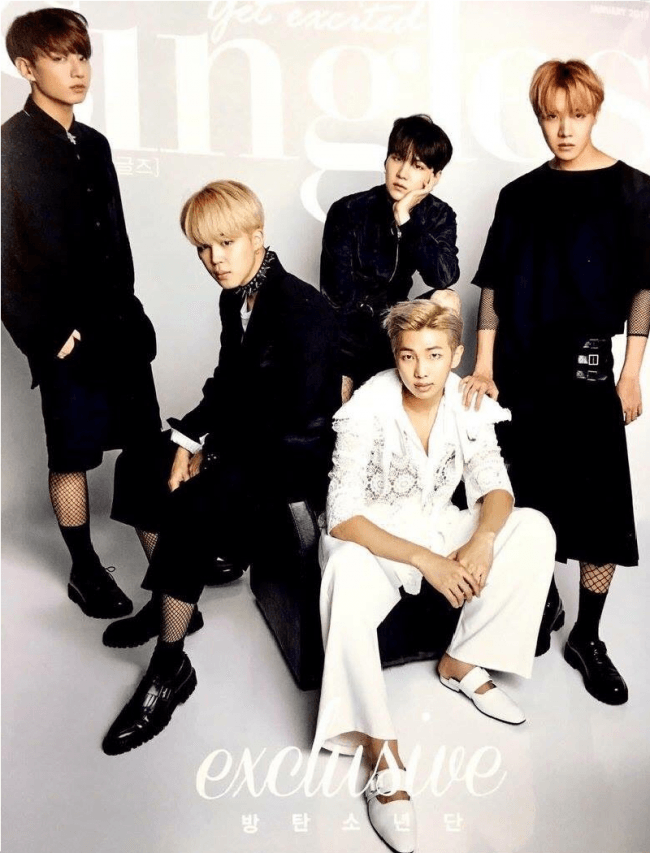
Many more male K-pop idols are sporting a clean-shaven look and are beginning to wear makeup, uncaring about the small group of comments who may accuse them of being ‘gay’. Beyond celebrities as well, many Korean men are beginning to take part in more ‘feminine’ activities, such as wearing bb cream and utilizing skincare. While it is true that South Korea has not completely moved on from the traditional masculinity – sculpted abs and a strong jawline are still considered part of the male ideal – it is clear that Koreans are not as focused on the western world’s ideal male, and instead are paving their own type of masculinity and image.
Article Mentioned: https://www.bbc.com/news/world-asia-42499809
Photos: https://www.koreaboo.com/stories/bts-wears-dresses-skirts-new-gender-bending-photoshoot/

 The Politics of K-Pop
This blog post discusses the changes in masculinity and how masculinity is presented within Korean Pop culture. The author concludes by saying that Korean’s perception of masculinity is not interested in the western ideal and “paving their own type of masculinity and image,” yet I wonder if this divide can be separated so simply. The Choi reading discusses the fan’s impact on Kpop content by their strong engagement, so how can Western and Korean ideals of masculinity remain polar if kpop thrives from foreign responses? It is true that Western perception of Korean men in Kpop often mediate in terms such as “girl-ish” or “gay,” but as Western understandings of gender and masculinity begin to change- which I believe is a topic of deep discussion in the United States- how does that affect idols and athletes in Korea? Muscular Korean athletes became popular in Korea because of their acceptance within the International realm. I believe today’s idols, who wear makeup, extravagant clothing and are comfortable with “softness,” are aiding the changes in perception of Korean masculinity in the West, as well as general understanding of the bounds of masculinity for all.
LikeLike
Koreans have been setting their ideal standards for men against the US standards for a long period of time. I agree with your point about Koreans starting to create a new trend of the concept of “flower boy” as many idol groups start to emerge with cute or pretty concepts instead of concepts that demonstrated the ideal form of masculinity (e.g. as you mentioned, Rain). However, I believe the concept is not a newly incorporated one. Back in the 10th century when South Korea was going through the Silla dynasty, a group of young intelligent men referred to as “Hwarang” (“Flowering Knights”) who studied their traditional culture were known for their cleanness, use of makeup as well as the excessive accessories. However, Hwarang were also able to fight for their kingdom. This elite group of men is being considered the heroes or legendary warriors as they are so brave yet sedulous at the same time. In today’s world, being an elite group that has both characteristics of “flower boy” and “ideal masculinity” is no longer a unique trait in k-pop groups. The word “duality” commonly seen under the context of k-pop idols is used to describe their ability to vary freely between the two characteristics. Therefore, I believe it is not that Korea has finally found their own stance or ideal standard on the idea of masculinity, but that they are simply more aware of the different kinds of characteristics individuals may have and from that, they are accepting and embracing it.
Referenced source: https://www.dailydot.com/upstream/k-pop-boy-bands-masculinity/
LikeLike
I do agree that the Korea’s perspective of masculinity has changed over the past decade. With the rise in K-pop, the “gender revolution,” and K-beauty, traditional masculinity is not the most desirable thing to embody. It makes sense that K-pop idols are the vehicle to which this trend has risen. The visual and affective component in music videos and performance is essential with K-pop idols through dyed hair, eyeshadow, and colorful costumes. I remember seeing Nature’s Republic’s advertisement for its skincare line with a whole K-pop boy group.
I’m interested in how makeup has become a trend by the means of the economy. This CBC article: https://bit.ly/2tsF6ip by Matt Kwong briefly touches on this idea explaining that the job market has stressed looking one’s best to beat competition. Kwong explains that because of the homogeneity of South Korea and the ubiquity of interview headshots, makeup is used to get a competitive edge in the market. This could explain the rise in the Korean men makeup industry as men-targeted products do not promote eyeliner but rather complexion based products to reduce the appearance of flaws –– to get the “chok-chok” look.
The men’s makeup industry then goes hand-in-hand with South Korea’s gigantic plastic surgery. The look that seems to be desirable is one that is fresh, youthful, and chiseled. I would argue that Western ideas of machismo don’t seem to be what is favorable in the domestic job market as “brooding” does not translate well into the perception of being a good employee. It reminds of Joo’s mention of the “salaryman” as one who takes care of one’s look can be seen as an eager employee. I would also argue that in the age of the free market and neoliberalism, the process of “optimizing one’s self image” is one example of how the current economy affects the individual and their aspirations.
On the other hand, Joo’s emphasis on the masculine sports athletes a way for Korea to be seen as equal on the playing field like swimmer Park Tae Hwan casually talking to Michael Phelps comes to mind as a counter visual. Joo notes that male athletes are seen as extensions of South Korea’s power as a nation in the globalized market. However, with BTS’ huge media following and breaking away from traditional masculinity, is the male athletic body still what holds the most weight for Korea’s international image? If the use of makeup has risen among domestic Korean men, will then the idea of “soft masculinity” or “metrosexual” becomes what Korea’s nationalism is based upon?
LikeLike