In “Transpacific Talent: The Kim Sisters in Cold War America,” Benjamin M. Han, an Assistant Professor in the Department of Communication at Tulane University, explores American Orientalism through the exchange of talent between the United States and Korea during the period of the Cold War. Throughout his work, Han refers to ideas such as the “perpetual foreigner” and “Americanized Asians,” along with referring to America as a “melting pot.” These concepts allow me to better understand why racial plagiarism is so prevalent within Asian entertainment both in America and in Asia.
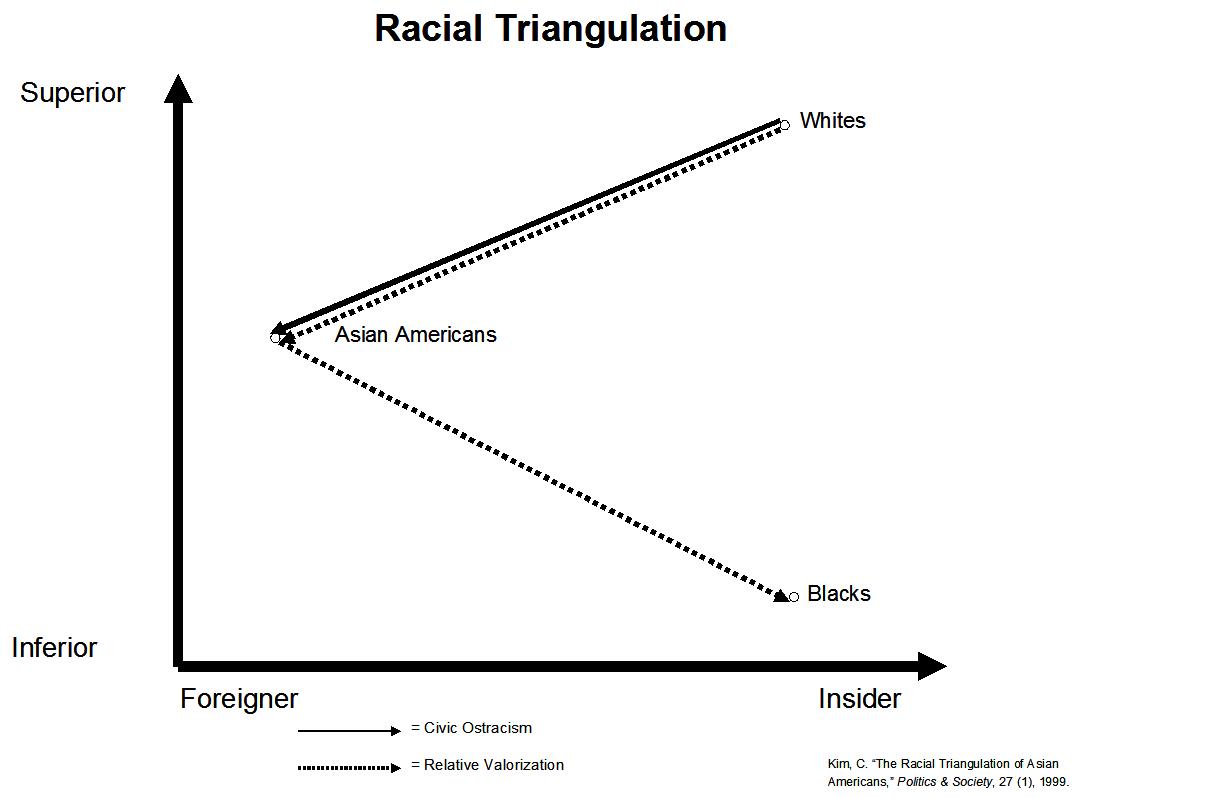
The idea of the melting pot is equivalent to assimilation. The metaphor implies a homogenous society, or a fusion of cultures, in which immigrants typically have to give up parts of their culture in order to fit in. On the other hand, the stereotype of Asians as the perpetual foreigner is the idea that no matter how long they or their family has been a part of American society, they will never be seen as true, genuine Americans. With this in mind, despite the systematic oppression they face, African Americans do not face this same issue of being labeled a foreigner. We see this in the theory of black, white, and Asian racial triangulation. This leads me to believe that because of the melting pot ideology and the want to dissolve the label of perpetual foreigner, Asians often racially plagiarize black culture in an attempt to do so.
We see a soar in popularity with Asian American music artists such as Brian Imanuel, better known as Rich Brian, and his record label, 88rising, which has done a remarkable job of bringing Asian artists into the mainstream. Sean Miyashiro, founder of 88rising, defines the goal of the label as “dedicated to celebrating global Asian culture.” However, black culture permeates many aspects of their work from the music and lyrics to the cinematography of the videos produced, even more so than Asian culture itself. Imanuel’s old stage name used to be Rich Chigga, and he even used the n-word in his song “Dat $tick.”
American rapper and actress, Nora Lum, better known as Awkwafina, donned a “blaccent” throughout her role as Peik Lin Goh in the film Crazy Rich Asians, monetizing blackness and black stereotypes to be rewarded in a way that actual black people are not. Black culture is so prevailing within Asian entertainment because by capitalizing on black culture, Asians are able to seem more like an insider and gain acceptance by the majority.

 The Politics of K-Pop
I find your post particularly interesting because I do see that essence of black culture permeating through other ethnic groups’ cultural products, but I wonder if that is actually the way to be seen as an insider. My skepticism comes from the perspective of the model minority myth. I find that there is an odd paradoxical moment in conjunction to you post because though Asians are indeed seen as the foreigner, they are also more accepted into society because they are labeled as the model minority citizen. The model minority citizen is typically used for other minorities (especially African Americans during the civil rights movement) to aspire to become in order to be accepted and granted access to similar privileges. Another flag I want to raise is understanding the difference between racial plagiarism and cultural appropriation. Considering racial plagiarism accounts for historicized socio-political dynamics between the supposed plagiarizer and the plagiarized, what is that relationship between Asians and African Americans? Is it really racial plagiarism if that socio-political dynamic is not as clear cut as White colonialism and the enslavement of Africans? Anderson stated that the adoption of cornrows by KPOP idols, for example, is not an example of racial plagiarism (though she said appropriation) because the significance of the cornrows is not equal to the Native American headdress. The racial dynamics between Korea and the black community in the US cannot be held to the same standards as racial dynamics within the US. With that being said, of course I don’t condone blackfishing or using blacccents, but I do wonder if 1) Blackness is actually a way to be seen as an insider when Asian Americans are historically seen as insiders, and 2) Whether the adoption of particular parts of Black culture can be considered racial plagiarism for Asians and African Americans.
LikeLike
I am intrigued by the argument you made that racial plagiarism has become a sort of “way in” to popular culture. As a Korean-American artist, I am very well aware of the lure that giving into certain trends in order to gain exposure. It’s easy to “cop out” and do what everyone else is doing, because it can make you feel pretty insecure about your music/art if you’re doing something a little different. I agree with Clare in that I don’t necessarily think that this is how minorities become insiders. Asians are the model minority, however, in terms of popular culture and the U.S. media, until recently (with the development of content that features Asian-Americans like Crazy Rich Asians or the label 88Rising), Asian-Americans have not received sufficient representation. Even now, we still have an incredibly long way to go before we can say that Asian-Americans are properly represented in all facets of American society. Additionally, we forget that the recent exposure that Asians have gained is only in regards to East-Asians. There is a chasm between the privileges that lighter-skinned Asians have in comparison to that of Asians with darker skin, like South Asians, that has yet to be broken, when it comes to recognition in popular American media. The U.S. has difficult focusing on more than one “star” of a movement, thus allowing for only East Asians to gain recognition and leaving little room for the rest of Asia. Even now, only some East Asian cultures are being acknowledged; South Korea is clearly at an advantage with acts such as BTS and Korean beauty sweeping the nation. On that same vein, I wonder if South Korea’s success in globalization will hinder the globalization of other East Asian cultures. Specifically, I wonder if the overwhelming acceptance of South Korea will diminish the chances of global acceptance of North Korea.
LikeLike
Your post reminded me of Muqing M. Zhang’s piece from Colorlines called “Performing Blackness Won’t Fill Our Asian-American Culture Deficit.” https://www.colorlines.com/articles/performing-blackness-wont-fill-our-asian-american-culture-deficit-op-ed
Zhang clearly notes how stars like Awkwafina, Lilly Singh aka Superwoman, and Rich Brian (formerly known as Rich Chigga) have profited off a persona of blackness. Lilly Singh is now even set to become a late-night host because of her YouTube persona and skits. She is an Indian-Canadian, but her persona has often relied on AAVE and black culture to gain her more success.
So much of Asian-American influencers and celebrities profit off of black aesthetics, culture, AAVE, and music. It’s clear in Timothy DeLaGhetto’s (Timothy Chantarangsu’s) appearances in Wild N’ Out and in other performers’ appearances that Asians have come into traditionally black spaces.
Someone like Cheryl Song, the first non-black dancer on Soul Train, was very successful after her longtime appearances on the show. https://www.youtube.com/watch?v=sTjdB366bhc&t=173s
What interests me is the viewers’ acceptance and/or turning a blind-eye to Asian-Americans using black aesthetics. People like Liza Koshy & Lily Singh are the most successful in capitalizing on AAVE rhetoric and slapstick comedy. I argue that their brown-ness may reduce the questions around their use of black aesthetics and AAVE as their visible brown-ness allows for them to blend seamlessly with less controversy. This seemed to have happened with Bruno Mars until recently as many critics are now more critical of Mars’ use of soul and hip-hop as means to profit off of –– another non-black person making money off of black culture.
In the case of Cheryl Song & Timothy Chantarangsu, they have entered majority black spaces like Soul Train and Wild N Out in which their ability to dance and rap respectively gives them validity in the space. One commenter on the hyperlink of “Soul Train” in this post commented “Now this* is cultural APPRECIATION 👏 she has a really nice way about her”. Many of the other comments validate her appearances through her ability to dance. In that way, Song “proves” that she is allowed in space, and DeLaGhetto does the same. In their case of Asian-Americans, entering majority black spaces is their validity in their presence, affect, and existence in the space? Is this an analogy to that of K-Pop and its relation to hip-hop?
Finally, there are East Asians that commodify and profit off of the black aesthetics like Rich Brian and Awkwafina. I argue in that racial triangulation is most visible here as both celebrities’ visible East-Asian-ness and fair complexion allow for critics and audiences to point out their use of black aesthetics. This s not to say that the critics are unfounded. Unlike Song and Chantarangsu, their East-Asian visibility is not coded within black contexts. Awkwafina and Rich Brian stand alone in their fields, having no immediate way to prove their merit.
This is all to say that the visuals and contexts to which Asian Americans use black aesthetics changes the way audiences receive them.
LikeLike