The Korean Beauty market is just one of the aspects of the current Hallyu wave which has exploded globally over the past couple of years. As people’s interest and obsession over k-pop idols and k-dramas increased, so did the desire to achieve the same aesthetic that their favorite actors and actresses donned regularly. Now, on many different social sites ranging from Twitter to Youtube you can find people in western countries raving about the fashion, makeup, and beauty aesthetic sported by their favorite korean celebrity. There are tutorials on how you can achieve these idealized looks and blogs which specify where k-idol’s clothes were bought from, and they’re endlessly consumed by a western audience.
When discussing the way the East Asian beauty standard spread to Vietnamese sex workers, Kimberly Huang discusses how Wonder Girls were idealized as an epitome of femininity. But the reasons behind why the beauty standards were adopted differ from those of a typical k-pop fan. Huang notes that “less developed Asian countries like Vietnam look to East Asia to represent modern cultural ideals.” When looking at this reasoning, it then begs the question why a western fan in a country just as developed as South Korea would also romanticize the beauty ideals and market of an East Asian country.
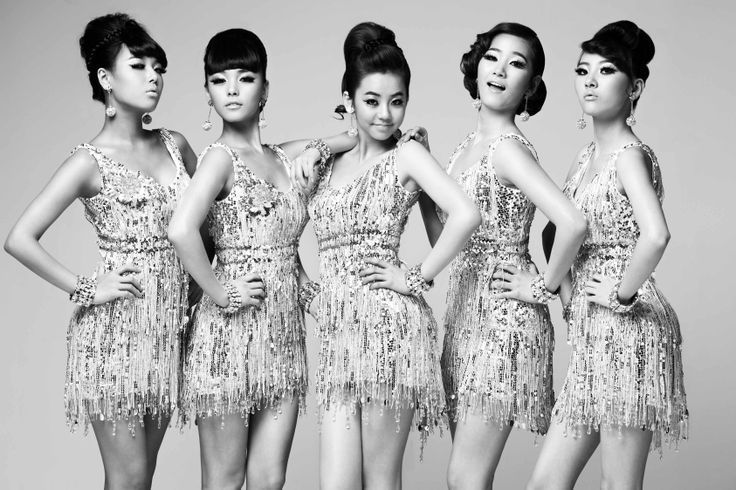
When I visited South Korea during spring break of this year, I was stunned by how strong the beauty standard was there. Almost every young individual I saw was following this template of beauty and fashion, and made anybody that deferred from it stand out even more. When discussing this phenomenon with my Korean-American friend, she brought up how she always felt slightly like an outcast when visiting South Korea because she didn’t follow these standards. It made me think about how many people conformed to a style of make-up and dress simply in order to fit in and be accepted by others in South Korea. And, furthermore, whether this desire to fit in extended to western fans of K-pop.
Even though they are physically far away from South Korea and the societal pressures present within the country, western fans still may feel a need to follow them in order to be accepted by a society and culture that they heavily idolize. Their love for a certain Korean celebrity may urge them to conform to what they believe the idol sees as beautiful, or even aspire to look like them, promoting a surge of interest in k-beauty. In this way, following the beauty standard of South Korea may make them feel more accepted into that community, and make them feel more similar to their favorite korean celebrity.
In theory, following a beauty trend is harmless, but when a beauty standard of another country is so heavily idealized, I can’t help but wonder whether it’s healthy for anyone, whether East Asian or not, to feel the need to conform to a certain aesthetic in order to feel accepted.

 The Politics of K-Pop
This week’s reading is really relevant to the final project that I am currently working on. For my final project, I am doing an analysis of the evolution of beauty ideals in KPOP so it was interesting to further read about Korea’s obsession with plastic surgery, and it was especially fascinating to read about how Korean beauty ideals have shaped the beauty aesthetics in other Asian countries as well towards men and women. Majority of the Korean society prefers Western aesthetics and features such as double eyelids, and high nose bridges, rather than embracing their own asian features. It’s interesting though because the result of the cosmetic surgeries actually makes them look more Korean. Korea places high value and importance on beauty and equates being beautiful with social, economic success. Due to the society being so fixated on beauty, I think it is impossible for one to be nonchalant or not care about their looks which is why I think many people in Korea care so much about their looks. One thing I noticed about going back home to Korea is that Korea focuses and prefers one type of look, the “western beauty”. One of the things that was brought up during recitation was how one person mentioned “stop it, you look Vietnamese”. While growing up, I also was warned by parents and adults with remarks like “Oh if you keep going playing outside, you are going to get tanned and look like a Filipino girl.” And being young and told that constantly, I accepted that as a “not a good thing”. This makes me wonder who created and how these beauty standards and connotations came to be.
LikeLike
While the rising popularity of Hallyu and all thinks K-pop has enabled visibility of South Korea and thus a sort of rising national pride within myself as a Korean-American,
While my initial reactions to more “professionally” made makeup videos are one of ambivalence since I do feel that K-beauty is now a look of its own, there are certain instances in which I feel that the aspiration is one stemmed in the patronization and generalization of Korean physiognomies. One extreme example I’ve unfortunately stumbled upon is a video of a young girl using actual glue to glue her double eyelids together in order to create the “monolid” look. Gleaning from our previous conversations about how K-pop and Hallyu can also be seen as a day-to-day performative identity, what I’ve noticed in these rather cringey videos is that after completing this sort of “Korean” look, these content creators feel much more comfortable performing the “Korean” stereotype of acting cute and “aegyo”. While wearing makeup to feel more confident is nothing inherently wrong, this sort of performance not only adulterates the perception of one’s self by convincing them that they can be Korean just because they look Korean, but also somewhat ruin the image of Koreans themselves by reducing them to one singular “look”.
LikeLike
The point you made about western fans looking towards Korean style and aesthetics as a further appreciation for their favorite idols is very interesting. You mentioned that a Vietnamese interest in Korea as the modern does not quite relate to the western view of Korea. Perhaps, since western fans of Kpop are much more exposed to Korean trends and the Hallyu wave than the mainstream western society, their view does in fact see Korea as modernity; a new modernity, or maybe even a post-modernity, something ahead of the United States. In kpop communities, Seoul Fashion Week is even more sought after than Paris or New York. Yet, I have also witnessed this interest turning towards fetishization. Some fans are no longer satisfied with solely using the same brands as their idols, they are now learning a new style of makeup which changes their facial features to look Asian, or at least biracial. This is interesting in context to the appearance trends occurring in Asia, like double eyelid surgeries. Are western fans who want to appear Asian as well, looking at the same influences of Asian trends that local Asian populations are looking at?
LikeLike
I share the same doubt as your question in the end on whether or not the obsession with “Standardized beauty” is necessarily healthy. As the rise of Hallyu has caused the cultural and social industry to be more widely exposed to the world, it has also resulted in huge immersing interest in Korean beauty ideals and standards. The relationship between the impact of plastic surgery and the uniformity of Korean women’s desired looks is mentioned in terms of “individuality”. As Professor Lee’s study discusses the history behind the huge increase in plastic surgery and explains why South Koreans are so drawn and even “obsessed” to this practice of beauty, she compares the concept of “lookism” to a lot of different ideas like alcohol, and empathy, and how it’s especially heavily emphasized in the workplace, workplace, and a high-paying job. The topic of beauty standards also relates closely to my final project which concerns the overall question of how have the trends or images of KPOP idols influenced South Korea’s overall perception to beauty in today’s world? According to research done by the International Society of Aesthetic Plastic Surgeons, one in five South Korean women has had some form of cosmetic surgery, compared to one in 20 in the United States. Beauty has become an expectation in South Korean society, as being beautiful is equated with professional and economic success. In South Korea, job applicants are required to submit a picture of themselves along with their resume. I find this topic very interesting as the notions of beauty and productivity, two unrelated ideas, slowly come together in South Korean society.
LikeLike
I think you raise a very interesting point about Korean beauty standards with K-Pop idols in the context of Western fans who are consuming and internalizing those standards. I think that it is common for Western fans to look like their idols, or feel more accepted within K-pop fandom, or perhaps it serves as an escapism, where they can meet the beauty standards that their favorite idols find desirable. And I agree that it is unhealthy for anyone consuming K-Pop to internalize these rigid beauty standards and aesthetics, but I also feel that it is even more problematic when non-Asian fans are altering their appearance (sometimes permanently) in extreme ways to look like idols. I think some non-Asian Western fans use K-Pop to fetishize Korean people and Korean culture, and one of the ways that manifests is altering their appearances. I think this ends up becoming cultural appropriation because they’re using K-Pop as an aesthetic, rather than valuing the music and the people performing it. In regards to the plastic surgery industry, this article follows the story of a white British man who spent $75,000 to look like Jimin. Unlike the Vietnamese sex workers who were getting procedures done for economic and geopolitical reasons, this man got plastic surgery because, “I love that kind of perfect image, they all look like dolls.” He is just objectifying Korean idols, and essentially has changed his race. As Professor Lee mentioned in lecture, it is interesting to note the ways in which plastic surgery is often racialized.
LikeLike
This topic is fascinating to me because I like to watch make-up tutorials on YouTube and often come across videos that incorporate Korean beauty brands and trends. When I look up tutorials, the tagline I’m interested in is the natural make-up look. My favorite makeup artists to watch is Lisa Eldridge, a British professional celebrity make-up artist and the Make-Up Creative Director of Lancome. Back in 1998, Lisa Eldridge was contacted by the Japanese brand Shiseido to create a new make-up line for the Asian market. Fast forward to the present, if you look up “Lisa Eldridge korean” on YouTube, you will find several tutorials within the past four years where she teaches about Korean or Japanese make-up looks. I like her videos because her expertise allows her to provide in depth observations about the technology and features of product or trend. One of these videos is titled ‘East Meets West’, where she explains her qualifications and the different approaches to beauty in these different parts of the world. This video isn’t about which style is better, but rather about giving insight to social or cultural factors that shape make-up trends. So going back to your point about adopting, it’s so interesting to think about non-Asians in the U.S. and other western countries wanting to recreate these looks because some of these face-tuning techniques are inspired by western beauty standards themselves. Western beauty (along with other cultural products) is often associated with “modernity,” so having Korean beauty trend be the new guideline has the same potential to create a new consciousness among non-Asian, impressionable youth that look up to these idols. One the one hand, this can result in an appreciation for Asian beauty that previous generations did not support. On the other hand, it can also lead to a negative reflection on the self that creates anxieties over self-acceptance.
LikeLike
I really like when you made the claim that western fans on Youtube and Twitter may be fascinated in re-creating K-beauty regimes and fashion because “western fans still may feel a need to follow them in order to be accepted by a society and culture that they heavily idolize.” I agree with this a lot but I also feel like K-beauty also advertises how to get the “perfect skin,” by doing many steps in skin care or makeup. This is something that I have turned to Korean beauty to mimic what they do because I associate K-Beauty with perfection within their products and routines. Going off of this, I think this is because the West does desire what seems to be perfection and this feeds into capitalism by buying products.
LikeLike