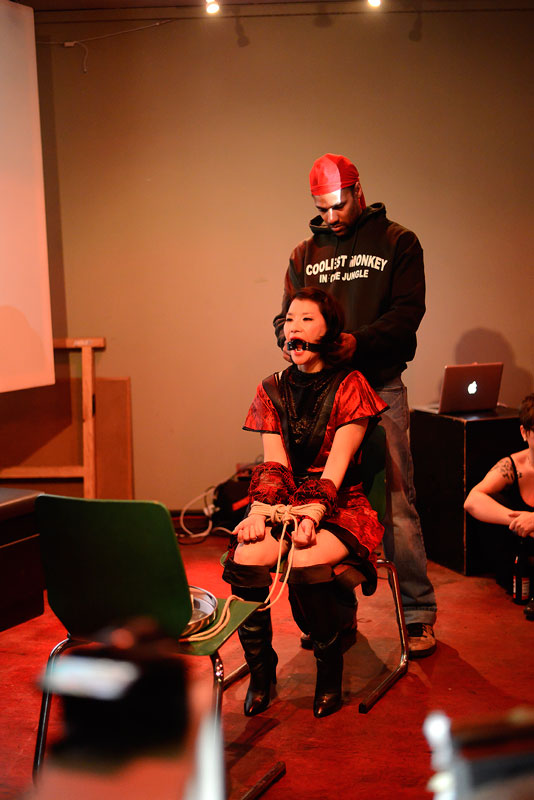
I love how Kate-hers RHEE transforms the art of activism and protests by turning them into a performance art with an underlying message with audience interaction. Of course walking protests, journal articles, and even social media posts can make a difference in starting change, but I think what RHEE has discovered in activism for Cultural Resistance is truly phenomenal.
In Brett M. Van Hoesen’s article he mentions RHEE’s demonstrations of performances that are groundbreaking to “make visible to the majority what is experienced by the minority.” By actively demonstrating what is experienced by the minority such as effects of white privilege or racist micro-aggressions, this forcibly makes the audiences unable to not participate or see the effects of these racist issues. They also make audiences mentally understand the importance of understanding stereotypes and racist etymology represented in performances such as the N-kissing Booth and the food art intervention Minimally Korean which touched on “White Privilege.” Before reading this piece, I had never thought of the West’s attitudes of owning other cultural foods and acting of ownership until reading this article and thinking about asian food markets or streets stands that we find in the United States or outside of it.
I think what is most brilliant about RHEE”S implements of the reward system is how it recruits participants in her performance, but it is also achieving making viewers understand the message she is trying to get across in having the audience’s personal confrontation of their own involvement in racism. I think this is important to have more interactive plays or performances with underlying messages. I think performances like the ones mentioned should be more advertised or instilled upon the performance culture. It is a lot better than simply writing or tweeting about an issue such as race, privilege, or entitlement.

 The Politics of K-Pop
In regards to interactive art exhibitions or installations, my mind immediately goes to Marina Abramovic’s interactive exhibition “The Artist is Present” at the MoMA in 2010. It consisted of a pair of chairs, facing each other, with the artist herself occupying one of them. The public was invited to sit in the empty chair across from the artist and make eye contact with her for any length of time. Although it seems like a simple concept, many people who participated were moved to tears, saying that the prolonged eye contact was profoundly emotional and personal. For me, this is the essence of interactive art exhibitions: to both make the art personal for the interacter, as well as incorporate these emotions into the art itself. I think that this goes with the point you made in your blog post, that interactive art is more efficient and effective in confronting social issues such as internalized racism or sexism. People tend to act on issues that have actually personally influenced them, and the interactive aspect of these art exhibitions definitely affect people on a much more personal level. I definitely agree that a tweet or a news article still feels like the idea or perspective of someone else, whereas interactive art exhibitions immerses you in that perspective so you participate.
LikeLike
I also feel that performance art like kate-hers RHEE’s can have a more powerful impact on the audience. Interacting with art forces the audience to take responsibility for how they interpret it. Because it is not as simple as watching a prerecorded video and shutting it off, the audience has to engage with the content and actively contextualize it for themselves.
I really liked RHEE’s “N-Kissing Booth” and the food art intervention “Minimally Korean” because they forced the audience to not only confront interpersonal / societal biases, but also to question where they come from. As a Korean American adoptee raised by a white family, I decided to major in Social and Cultural Analysis with a focus in Asian/Pacific American Studies. As a transnational and transracial adoptee, I often have trouble explaining issues of race to my family members. While they are acknowledge societal differences in race relations, it is hard for them to contextualize my experiences of being non-white, as they simply consider me as their son / brother. In order to open up conversations about race and diversity, I believe people need to actively seek out knowledge from others’ experiences, and performance art like RHEE’s is a great way to start such discussions.
LikeLike
The discussion about Kate-hers RHEE’s performance art and her other works’ in other forms was very interesting to read. I really appreciate the fact that RHEE portray and presents her art pieces in ways that really interact with her audiences. For instance, the double eyelid tutorial – a short video that supposedly imitates Asian makeup tutorials in the pursuit of the ‘perfect eye look’ for Asian girls. The general appearance of the film seemed normal, like it was any other makeup tutorial, but the ‘comments’ on the bottom of the video really exposes and talks about the racially biased notion and concept that ‘Asian eyes’ make Asians seem untrustworthy, but if you get our double eyelids you can achieve what people of others races can do to. You can get a good job, a proposal and all sort of benefits, just by changing this one common Asian facial feature.
It seems in a subtle and unseemingly way, RHEE successfully attracts the attention of many people to her art projects and slowly exposes them to them to certain concepts about racial inequality and why these unfair treatments and assumptions made against some races are very problematic. I think her artworks really fulfills the ideal where art imitates life, in that her art pieces are able to convey her messages to the society through real life events with aspects about these event magnified in order to point out daily but threatening social or race related issues.
LikeLike
Your discussion about interactive art pieces reminds me of Japanese art professor Seiko Mikami’s large-scale installation, “Seiko Mikami: Desire of Codes.” His piece consists of ninety security cameras mounted on a wall along with six robotic camera arms. As you explore the exhibit, the cameras follow you around, and the subsequent images appear on a separate wall nearby. This art piece is to explore the idea of modern day surveillance and how we, as a public, are often being watched and videotaped without us noticing; the installation ties with the idea of privacy. By including the audience within the art piece, it asks for a more active audience that may be more willing to understand the exhibit. I also think interactive exhibits allow for some level of discomfort as one doesn’t have a set idea as to what will happen. I think discomfort can be really powerful in a piece of art if used effectively because it is calling for a response out of the audience; it purposely makes the audience feel. Being a part of the exhibit itself, which emotes these feelings, forces one think about this art on a more emotional, personal level, leading to more well-rounded perspectives.
LikeLike