Military involvement had been a common cause of many issues in Korea such as prostitution and children in the streets of Korea during the 1950’s. The stigmas in Korea against mixed-race Korean kids was the main reason the children were sent away to be adopted or live in foster care in the West. Men were prioritized in sustaining from adoption throughout this process in the early 1950’s . In Eleana J. Kim’s article “Producing Missing Persons: Korean Adoptee Artists Imagining,” Kim mentions the Korean boys adopted into Western families joining communities to find identification which shows the importance of the internet and how the media can help find individualism and identification with their lost community.
An example of the struggle of self identification would be the successful Olympic skier, Toby Dawson. In class we watched a news story about his trip back to his home country after having a victory at the Olympics in 2006. When South Korea heard of his success and that he identified as Korean-American, they took initiative to find his birth parents in Korea and invite him to their country. He was relieved and emotional to finally be able to return to “home” and be accepted. He talked about how his mother was possibly treated and how he was treated for not being a pure race Korean.
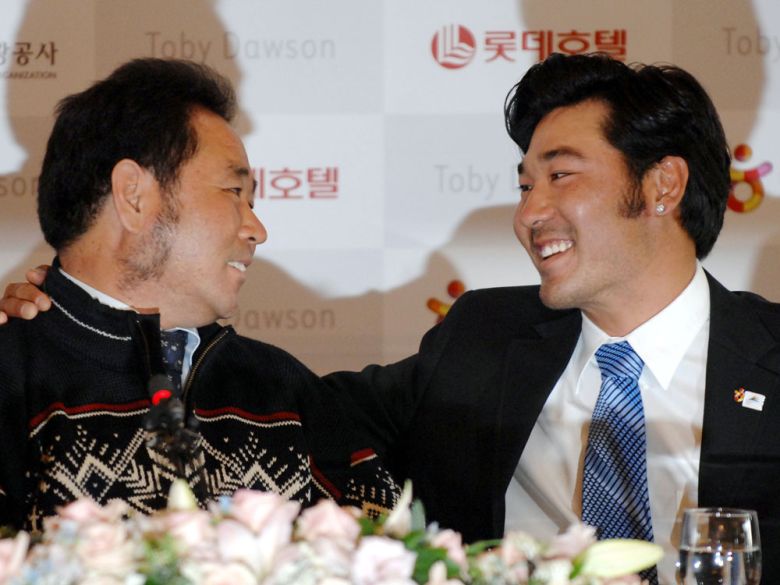
Social belonging is a huge issue among mixed race children. For example you hear of mixed black children being too “white” for their black peers, and too “Black” for their white peers causing a dissociated interaction throughout their growing and educational years. Same can be said for Korean mixed-Race children and feeling a sense of not belonging.
The “emergence of the adult adoptee subculture” became a product of the social isolation of these adopted mixed-raced Korean’s which turned into a great community for other adults trying to find themselves among their culture. From these adoptee subcultures they started participating in “community and the global art world” (KIM 77). This formed a community trying to help with the cultural displacement of the adult adoptees. Mostly photography and movies are made to give a valid and surreal representation of the life of an adopted child growing up in the West which gives them “greater self understanding” (Kim 78). KIM also mentions in her article that the adoptee artwork is a form of activism and brings cultural awareness to surrounding peers in their communities or outside of their communities. It could be analyzed and claimed that Toby Dawsons art contribution to this community would be his career in skiing and his interaction with his family that came from his growing fame as an athlete.


When I read Kim’s article, I also thought about our Toby Dawson and the conversation we had around Korean identity at the beginning of class. As an outside, the international adoptee narrative is usually a story of when and how the adopted person eventually meets the original parents or goes back ‘home.’ In the art installations Kim explored, the author interprets the narratives portrayed by international adult adoptees as one of transnational collective identity among Korean adoptees. Their work doesn’t only touch upon the their desire to meet their biological family and conflicting identities, but it helps shine a light on an adoptee experiences that involves racial, cultural, and geographical self-awareness. To your point about, Toby’s contribution to community formation for Korean adoptees, I can see how his fame through his Olympic career gave international exposure to the conversation around Korean adoptees in the United States. As we saw in the video, however, the media from both countries did, in fact, split his identity in whatever way seemed convenient (“American athlete adopted from Korea for a better life” for the U.S, or “Korean Olympic Athlete reunites with family” for Korea. So I think the author here wants to bring attention to other conversations Korean adult adoptees want to have, which is one about them disidentifying from the simplistic half-and-half discourse, and more about individual and collective experiences.
LikeLike
I too was reminded of Toby Dawson when doing this week’s readings. The way his identity was portrayed in the media, and the way he discussed his own identity was very interesting, and I’m sure could be analyzed from the lens of adoptee culture. What I think is most important here, however, is the simple act of bringing to light adoptee culture. So many people assume that once a child is adopted, they automatically assimilate fully and seamlessly into American culture, but often this is not the case. Transnational adoption can leave children with a myriad of emotions to navigate, and often creates complicated ideas of identity. This is a phenomenon that most people are completely unaware of, even to those who partake in this adoption process. I believe that it is crucial for artists, athletes, public figures, etc., to bring awareness to these issues. Many parents adopting these children are not prepared to address these issues of identity, because they are unaware. Often times it is assumed that so long as the child is fed, clothed, and given an education, their life in America must be perfect, but we know this is not the case. We can not fix the problems that these adoptions pose without first acknowledging that there is a problem to begin with.
LikeLike
Toby Dawson also came to my mind when reading and examining Eleana J. Kim’s article, “Producing Missing Persons: Korean Adoptee Artists Imagining.” Figures like Toby Dawson are often used to illustrate the happiness of finally being supposedly home and meeting your birth parents. However, I think it is important to note that South Korea only claimed Dawson as one of their own and helped track down his birth parents after he was shown to be successful, competing in the Olympics. Those who are adopted often lack an understanding of their identity and where they belong in the world. Public figures like Toby Dawson allow for other adopted children to have a model to look after, an understanding that one’s identity is not binary, and you do not have to choose either or. They allow for subcultures to form as one can more easily find others who have gone through the same experiences he or she has, forming a community that understands the complexities that come with being a transnational adoptee. This is important as adoptive parents may often lack the required knowledge of the adoptee’s cultural heritage to be able to effectively help them navigate the journey to find their identity.
LikeLike
Adding onto the conversation about Toby Dawson, I want to bring up our previous in class discussion about Hines Ward. I think that there is a slight difference between the stories of the two men, as Hines Ward knew his birth parents, but struggled with finding his place in society due to his biracial background. Whereas Toby Dawson seemed to have an arc of finding his “people” and his belonging, Hines Ward seemed to have to earn his belonging into society, which is eventually does with his successful football career. However, this brings up a question of what this sort of liminal space is where adoptees or mixed race children seem to float, unsure of their postion in society. It seems to me that existing in this liminal space is in and of itself enough of a uniting factor between people. For example, children that identify themselves as “third-culture” children have, from a young age, not known where their conceptual “home” truly lies. Rather than a geographical location, they tend to name people or abstract emotions as a definition of home. This becomes a uniting factor between third-culture kids, and they become each others’ comfort, and thus subculture. Thus, this liminal space, this “third culture” between cultures, can be interpreted as a culture itself.
LikeLike
I think that the idea of social belonging is one of the most influential aspects of society. From a young age, we are taught that being popular was cool, and that we should “keep up with the trends” to be able to have a conversation about it with our peers and “fit in.” I think that given how America is quite progressive compared to Korea, there is more visibility for discontent over social norms. People are starting to question what “fitting in” actually means and embrace being different, especially since conformity can lead to extreme results, such as groupthink, in history.
I think Korea is still more conservative, and that means a different narrative for kids growing up in Korea. That and the rise of multi-racial children growing up in Korea means more cases of bullying and ostracizing those different from the “norm.” It is interesting to see how wasian kids in Korea wanted to get plastic surgery to look more Asian. However, there appears to be more people who are speaking and representing biracial cultures, such as Han Hyun-min, who is a South Korean model who is half Nigerian and half Korean. However, there is still much to be done to push Korea in a forward direction at a faster rate.
LikeLike